

Projects
31 August 2026
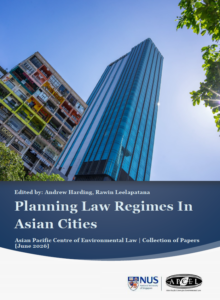
On 16 April 2019, the Asia-Pacific Centre for Environmental Law (APCEL) at NUS Law hosted a workshop on “Planning Law in Asian Cities”. The Workshop was a first in looking at planning law regimes in Asia and was convened by Professor Anfrew Harding and Associate Professor Jolene Lin at NUS Law.
The chapters in this volume originated from the papers presented at the seminar, they reflect the law and factual circumstances as they stood at the time of writing or first publication.
The collection examines planning law as an underdeveloped but vital field in Asian legal scholarship, comparing how law structures urban development, decision-making, accountability and public participation across the major Asian cities, i.e. Bandung, Bangalore, Bangkok, Johor, Hong Kong, Metropolitan Manila and Singapore. Together, the papers show that planning is never merely technical: it mediates conflicts over land, heritage, environment, infrastructure, economic growth and political authority. The volume highlights diverse legal regimes shaped by colonial legacies, constitutional arrangements, executive power, monarchy, informality and citizen mobilisation. It also reveals recurring tensions, including weak legal recognition of planning as a specialist field, limited litigation and appeals, uneven transparency, fragmented institutional authority, and uncertain avenues for community input. By placing Asian cities in comparative perspective, the collection argues for greater scholarly, professional and public attention to planning law. It invites readers to see urban planning as a central site where legality, governance and democratic participation intersect in rapidly urbanising societies facing mounting pressures from development, climate risk and demands for more inclusive cities.
Related Links:
- About Andrew Harding (co-editor)
- About Rawin Leelapatana (co-editor)
- APCEL Workshop, “Planning Law in Asian Cities” , 16 April 2019
- Book, “Planning Law in Asian Cities: Collection of Papers”