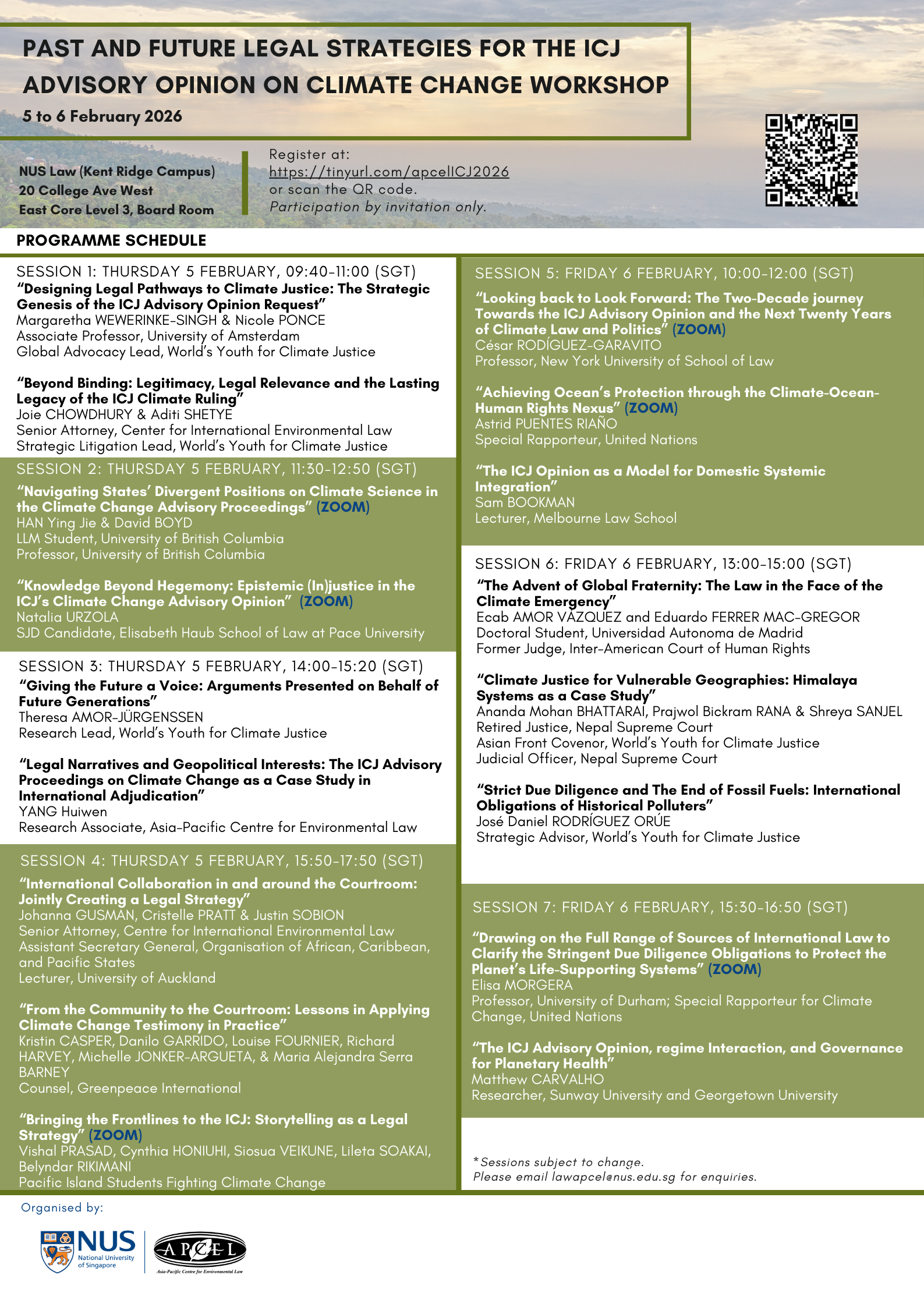

[APCEL Workshop] Past and Future Legal Strategies for the ICJ Advisory Opinion on Climate Change
- Events
- [APCEL Workshop] Past and Future Legal Strategies for the ICJ Advisory Opinion on Climate Change
February
05
Thursday
| Venue: | NUS Law (Kent Ridge Campus) East Core Level 3, Board Room |
| Type of Participation: | Participation by Invitation Only |
Description
About the Event
The ICJ Advisory Opinion on state responsibilities for climate change has been hailed to be a historic moment for climate justice. But it is not only the Advisory Opinion itself that is historic – the very Request, and the nature of the Advisory Proceedings have also been regarded to be a watershed moment for climate action and international law. While many projects have focused on anticipating the ways in which legal instruments and doctrines can be harnessed to clarify the state obligations in international law and the consequences for the breach of those obligations, little attention has been paid to the strategic nature of the Request for the Advisory Opinion.
Although the Advisory Opinion is itself a non-adversarial form of litigation, the choice to seek an Advisory Opinion to achieve climate justice is itself a legal strategy that demands attention from both litigators, scholars, and environmental advocates. The ways in which legal procedures and concepts were communicated to states and civil society, the text of Request for the Advisory Opinion and submissions from states were drafted, and the role of youth and frontline communities in shaping the legal arguments before the Court are some examples of exercises in legal imagination and strategy that have yet to be cohesively studied as a scholarly project.
There is thus much merit to follow the development of legal concepts, ideas, and procedures from the campaign for the Advisory Opinion. Importantly, doing so also provides a basis for the legal and environmental community to think about how past legal strategies can inform future ones. Future advocacy and litigation that seeks to rely on the ICJ’s Advisory Opinion can thus benefit from knowledge of the climate narratives and legal arguments that had preceded it. Failure to appreciate the history of the Advisory Opinion in the round fails to recognise the diverse and intersectional ways legal concepts and strategies can work to protect the rights and interests of those disproportionately impacted by climate change.
The proposed book thus centers the campaign for the Advisory Opinion in order to highlight the significant and novel legal developments arising from the Advisory Proceedings and Opinion. It is structured in two parts. Part 1 focuses on the legal strategies employed during the campaign, including both the strategies adopted by the youth that led the campaign and the states that participated in the Advisory Proceedings. With the release of the Advisory Opinion, contributions in Part 1 will also reflect on the extent to which these strategies succeeded insofar in bringing legal narratives and arguments before the ICJ. In contrast, Part 2 considers the future legal strategies that may be deployed following the release of the Advisory Opinion. It considers the likely impact of the Advisory Opinion on institutions and litigation across both international, regional, and domestic jurisdictions.
Contributions in both parts are expected to draw from the rich legal material spanning the following:
• The well-documented campaign led by the World’s Youth for Climate Justice and the Pacific Island Students Fighting Climate Change
• Written and oral submissions during the Advisory Proceedings from states and NGOs
• The Advisory Opinions of the ICJ, ITLOS, and IACtHR
Importantly, the authorship of the contributions and editorial vision for the book also seeks to be an inclusive platform by which junior scholars can work with more senior and renown scholars in international law. It is also a continuation of the inter-generational collaboration present throughout the campaign for the Advisory Opinion. In this way, it is hoped that the book will be both an example and a reminder of the ways in which the legal community must continue to work synergistically to develop new strategies to manage the complex crisis of climate change.
Registration
This event is ‘by invitation only’. Please email lawapcel@nus.edu.sg for enquiries.
Organised By

Asia-Pacific Centre for Environmental Law