

Media - News
APCEL STUDENT OUTREACH PROGRAMME: Bedok South Secondary School
On 29 April 2025, the Asia-Pacific Centre for Environmental Law (APCEL) welcomed students from Bedok South Secondary School for an afternoon of interactive learning at the NUS Bukit Timah Campus.
The workshop was introduced by Selene Tanne (Sheridan Fellow, NUS Law; Academic Fellow, APCEL), who warmly set the tone for the session and guided students through the day’s activities. The first segment was delivered by Dr Justine Muller (Post-Doctoral Research Fellow, APCEL), who introduced students to the concept of biodiversity and its importance — from sustaining ecosystems and clean water to supporting food security, scientific discovery, and cultural heritage. She then explored the legal frameworks used to protect biodiversity at various levels, including species, habitats, and trade.
Using the example of the leopard cat, students learned how various laws prohibit harmful activities, regulate trade, and support habitat conservation. International instruments such as the Convention on Biological Diversity (CBD) and CITES were discussed alongside Singapore’s domestic legislation, including the Parks and Trees Act, the Wild Animals and Birds Act, and the Endangered Species (Import and Export) Act. These legal frameworks were shown to work together to protect species and ecosystems, both globally and locally.
The next session was delivered by Justin Lim (Sheridan Fellow, NUS Law; Academic Fellow, APCEL, co-coordinator for the Singapore Front of the World’s Youth for Climate Justice). He introduced students to the role of international courts in climate change law by explaining the significance of two ongoing advisory opinion proceedings: one before the International Tribunal for the Law of the Sea (ITLOS) and another before the International Court of Justice (ICJ). Students explored how these tribunals interpret state obligations under international environmental treaties such as UNCLOS and the Paris Agreement.
Importantly, he highlighted Singapore’s active participation in these processes, drawing attention to how Singapore contributed to shaping the legal discourse on climate obligations at the global level. Through critical questions and treaty analysis, students were encouraged to reflect on how international legal interpretations are formed, and what role international courts and tribunals can play in driving environmental justice.
To conclude, Selene returned with a dynamic quiz that invited students to reflect on what they had learned throughout the sessions. Through this interactive wrap-up, students tested their understanding of key legal concepts while having fun and engaging with one another.
The visit ended with a short campus tour, leaving students with a sense of inspiration and a deeper appreciation of environmental law’s role in shaping a sustainable future.
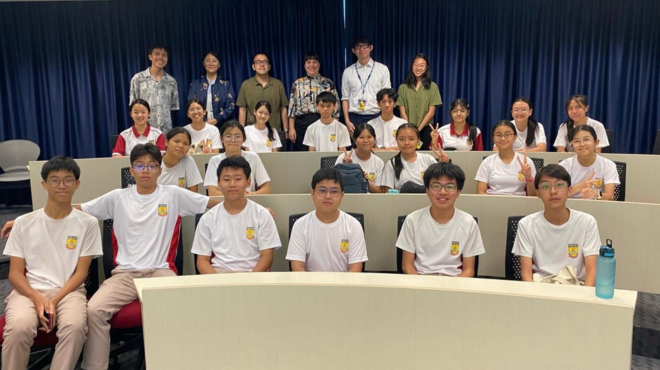
Image: Bedok South Secondary School