

Media - News
[APCEL Workshop] Biodiversity and Free Trade Agreement
International trade has been identified as a leading cause of biodiversity loss. From the direct impacts of transportation to land-use changes and pollution associated with the increased production of certain goods, international trade has extensive negative effects on ecosystems worldwide. Yet, the legal scholarship says little about both the negative and positive effects that international trade law, and in particular innovative environmental provisions found in bilateral and regional trade agreements, can have on biodiversity.
To kick-start the conversation on this growing and important issue, APCEL organised a two-day international workshop on 22-23 January 2026. It featured a group of 14 early-career and established scholars from Asia, Europe, and New Zealand.
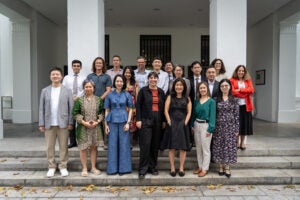
The workshop discussed several key and innovative free trade agreements, including the Comprehensive and Progressive Agreement for Trans-Pacific Partnership (CPTPP) and the EU-New Zealand Free Trade Agreement, as well as new forms of economic partnerships, such as agreements facilitating trade in critical raw materials.
Many aspects of biodiversity were explored. Some participants focused on the role of free trade agreements in mitigating biodiversity loss associated with certain economic activities, such as mining, fishing, or the commodification of genetic resources. Others discussed how to reshape international trade law to include biodiversity more meaningfully, for example, by recentring trade on other human-nature relationships, such as those present in the cultures of indigenous and local peoples in Asia and the Pacific.

One of the central topics was the implementation and enforcement of the biodiversity-related provisions of free trade agreements. This led to a discussion of international biodiversity law and its fragmentation, as well as the use of trade sanctions for environmental objectives. While participants acknowledge that the integration of biodiversity into free trade agreements remains soft, the workshop demonstrated that, if taken seriously by the parties, international trade law could play a significant role in addressing biodiversity loss.
This workshop was an important step toward the publication of an edited collection of chapters written by the participants and edited by Professor Jolene Lin, Director of APCEL, and Dr Justine Muller, post-doctoral fellow at APCEL.
Related Links: