

Media - News
The Green Plan 2030 Five Years On: From Policy Vision to Legal Reality
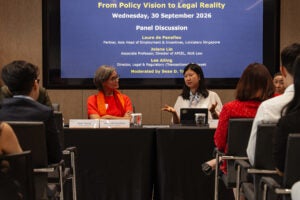
On 30 September 2026, the Asia-Pacific Centre for Environmental Law (APCEL) at NUS Law, in collaboration with Linklaters, hosted a panel discussion titled “The Green Plan 2030 Five Years On: From Policy Vision to Legal Reality”. Bringing together perspectives from academia, private practice and in-house counsel, the event examined how Singapore’s sustainability ambitions have shaped its environmental laws and regulatory landscape since the launch of the Singapore Green Plan 2030 in February 2021.
The event also marked the release of the fourth edition of the Singapore chapter of the International Encyclopaedia of Laws: Environmental Law, co-authored by Professor Lye Lin-Heng and Sean Tseng.
Opening the event, Sean Tseng, Senior Adjunct Research Fellow at APCEL and moderator of the discussion, highlighted how the Green Plan has served as an important policy anchor for Singapore’s environmental law developments. While many of Singapore’s principal environmental statutes predate the Green Plan, subsequent legislative amendments and regulatory initiatives have increasingly given effect to its ambitions.
Drawing on developments covered in the updated publication, Sean illustrated this evolution through Singapore’s escalating carbon tax, extended producer responsibility schemes, electric vehicle regulations, energy efficiency requirements and environmental assessment reforms. He emphasised that the Green Plan’s significance extends beyond legislation, encompassing fiscal incentives, infrastructure investment, institutional coordination and measurable sustainability targets.
The ensuing panel featured Associate Professor Jolene Lin, Director of APCEL; Laure de Panafieu, Partner at Linklaters; and Lee Ailing, Director, Legal & Regulatory (Transactions) at Temasek.
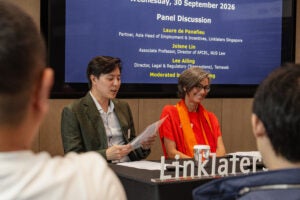

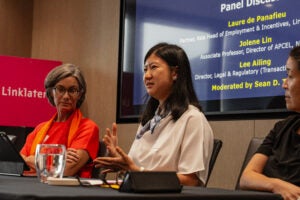
A central theme emerging from the discussion was the growing importance of corporate accountability. Sustainability commitments are increasingly accompanied by expectations that businesses demonstrate how their targets will be delivered. The panellists explored how sustainability risks are becoming embedded in corporate strategy, board governance and decision-making, including their implications for attracting and retaining talent.
The discussion also examined evolving regulatory and disclosure obligations, including SGX-related requirements and electric vehicle regulations. Beyond domestic legislation, the emergence of climate litigation internationally was highlighted as a growing source of legal risk for businesses, particularly amid signs of some companies retreating from earlier climate commitments. Against this uncertain backdrop, the importance of building business resilience across different possible regulatory, economic and climate futures was emphasised.
Looking towards 2030, the panellists considered areas where regulatory scrutiny could intensify, including recycling and waste management. Climate adaptation also emerged as an increasingly important priority alongside emissions mitigation, particularly as businesses and governments confront physical climate risks and the need to strengthen energy security.
The discussion ultimately underscored that Singapore’s sustainability transition is not simply about introducing new environmental laws. It is also about how businesses anticipate emerging risks, strengthen governance, embed accountability and translate evolving policy and regulatory expectations into practical action.
Five years after its launch, the Green Plan’s journey from policy vision to legal reality continues to unfold, carrying with it important implications for Singapore’s legal landscape and the businesses operating within it.