
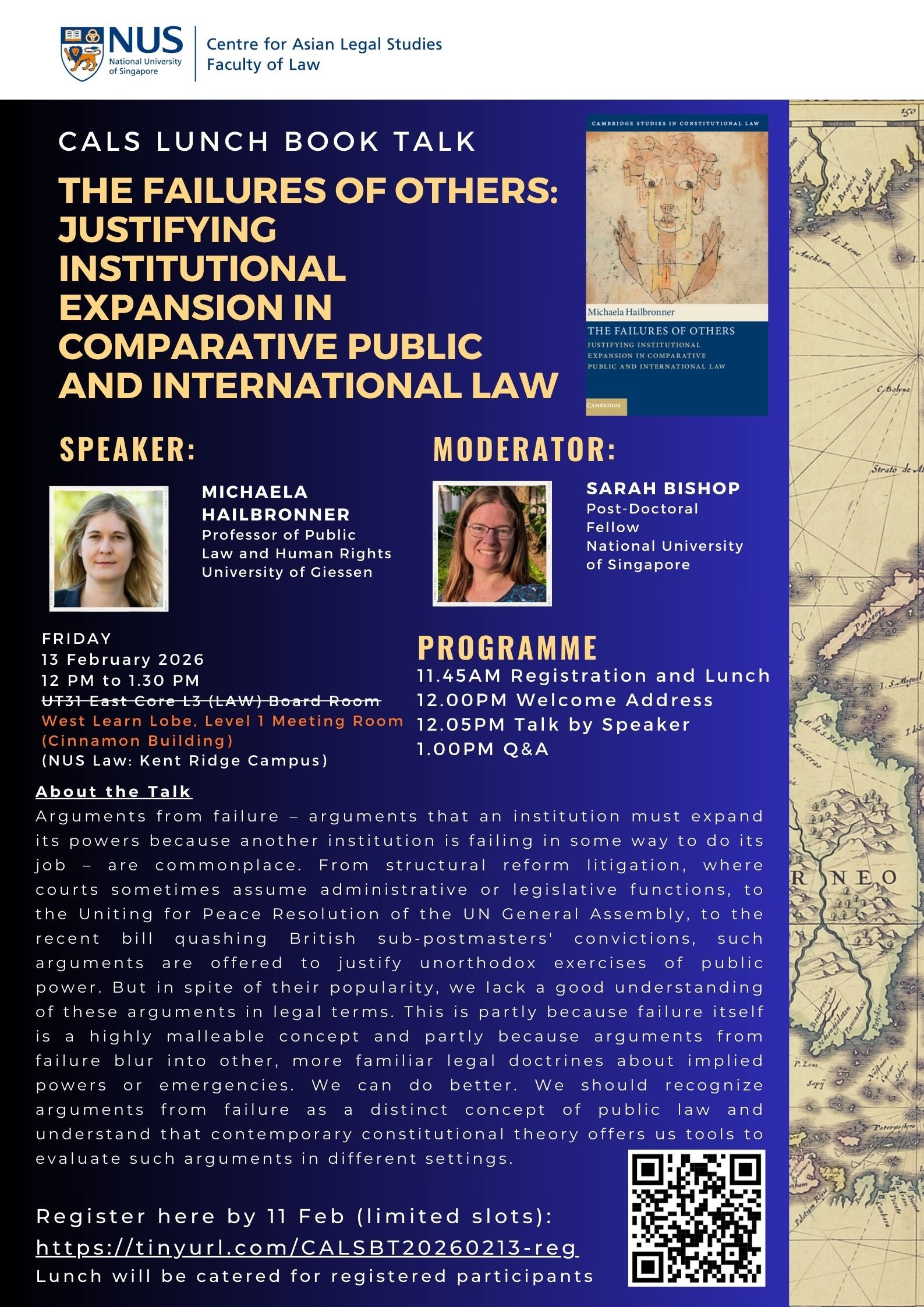
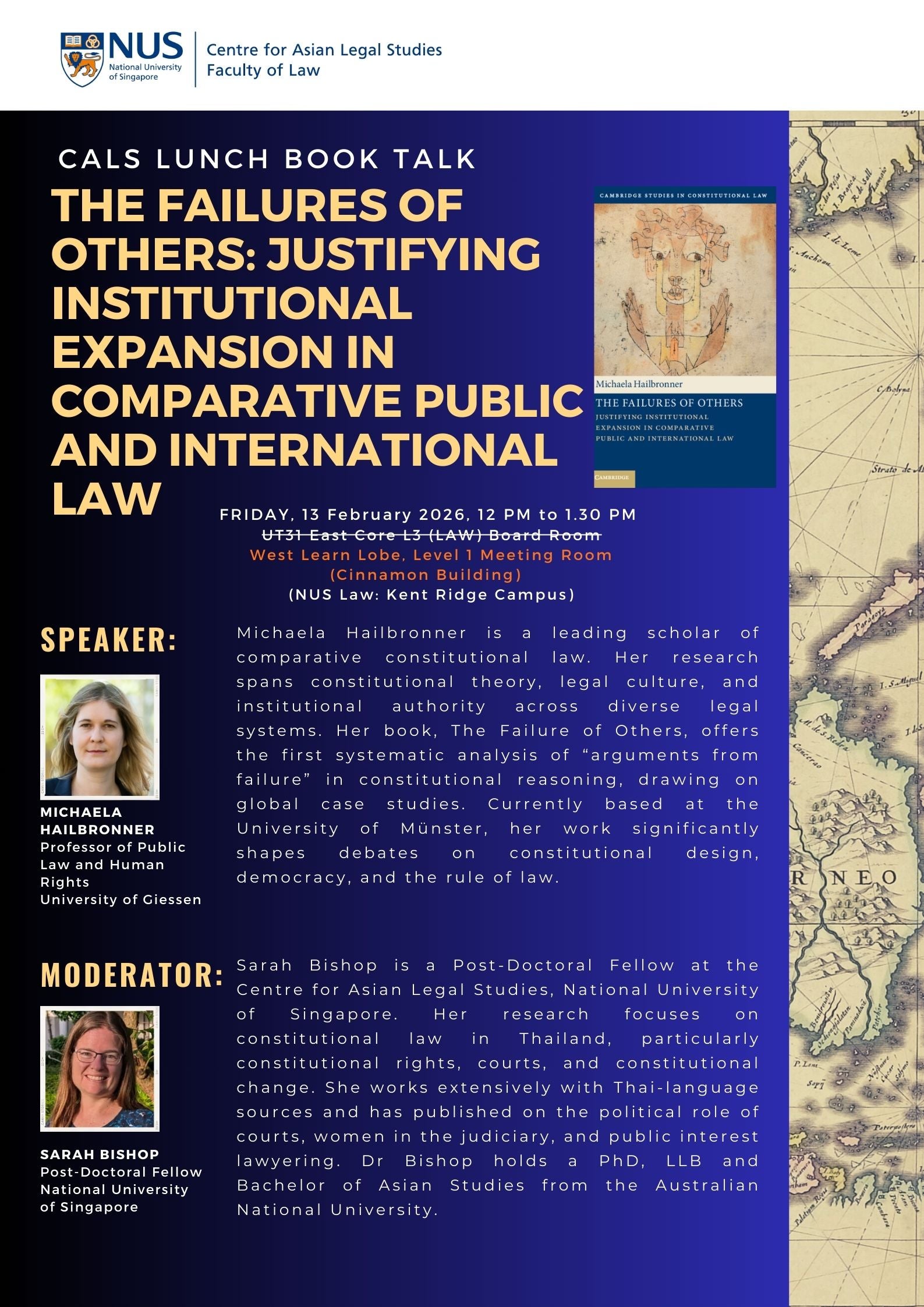
[CALS Book Talk] The Failures of Others: Justifying Institutional Expansion in Comparative Public and International Law
February
13
Friday
| Speaker: | Michaela Hailbronner |
| Time: | 11:45 am to 1:15 pm (SGT) |
| Venue: | PLEASE NOTE THAT THE VENUE HAS BEEN CHANGED West Learn Lobe, Level 1 Meeting Room (Updated) (Cinnamon Building) NUS Law, Kent Ridge Campus |
| Type of Participation: | Open To Public |
Description
About the Book
Arguments from failure – arguments that an institution must expand its powers because another institution is failing in some way to do its job – are commonplace. From structural reform litigation, where courts sometimes assume administrative or legislative functions, to the Uniting for Peace Resolution of the UN General Assembly, to the recent bill quashing British sub-postmasters’ convictions, such arguments are offered to justify unorthodox exercises of public power. But in spite of their popularity, we lack a good understanding of these arguments in legal terms. This is partly because failure itself is a highly malleable concept and partly because arguments from failure blur into other, more familiar legal doctrines about implied powers or emergencies. We can do better. We should recognize arguments from failure as a distinct concept of public law and understand that contemporary constitutional theory offers us tools to evaluate such arguments in different settings.
This work offers the first systematic exploration of arguments from failure—examining how and why institutions expand their authority in response to the real or perceived failure of others—and situates these phenomena within a broader legal understanding of institutional failure. It identifies and analyzes such arguments across a wide range of contexts, from structural reform litigation in the United States, India, South Africa, and Colombia to examples in German and UK public law as well as European and international law. Building on this descriptive account, it develops a normative framework grounded in the principles of the separation of powers, democracy, and the rule of law to assess the legitimacy of arguments from failure across these varied settings.
About the Author
Michaela Hailbronner is a leading scholar of comparative constitutional law whose work explores how courts and institutions negotiate power, legitimacy, and the demands of modern governance. Her research spans constitutional theory, transformative constitutionalism in the Global South, German public law, and the dynamics of legal culture in shaping institutional authority. She is widely recognised for her interdisciplinary approach, blending doctrinal analysis with insights from political theory and institutional design.
Michaela’s scholarship has been shaped by her broader interest in how constitutions allocate responsibility, empower or restrain state actors, and respond to societal expectations. Her work on legal culture has examined why certain courts command public trust, focusing in particular on Germany’s model of law as a scientific, expert-driven enterprise. She has also engaged in comparative studies of Asian constitutionalism, examining how welfarist commitments, judicial role conceptions, and doctrinal tools—such as proportionality analysis—operate across different legal traditions.
Michaela is currently based at the University of Münster and has held research positions at leading institutions around the world. Her intellectual contributions continue to influence debates on constitutional design, institutional failure, and the evolving landscape of public law.
Fees Applicable
Complimentary
Registration
Register here: https://nus.syd1.qualtrics.com/jfe/form/SV_3yHtFuF0dqFO6PA
Contact Information
cals@nus.edu.sgOrganised By