

Media - News
[CALS-NLSIU Workshop] Teaching Criminal Law: Curriculum, Syllabus & Pedagogy
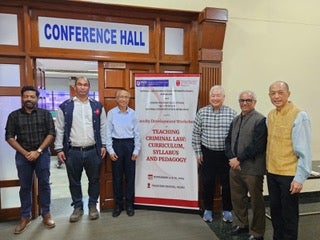
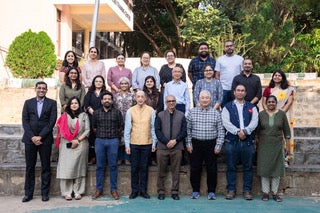
Stanley Yeo, Visiting Scholar Professor of Law at the National University of Singapore, played a significant and multi-faceted role in the two-day Faculty Development Workshop on teaching criminal law, jointly organised by the National Law School of India University (NLSIU) and the Centre for Asian Legal Studies (CALS), NUS Law.
The Workshop was held at NLSIU in Bengaluru, India, and attended by 22 criminal law lecturers from various law schools around India.
On Day 1, Stanley served as a panelist in the opening plenary session, which brought together leading criminal law scholars from across Asia to discuss pedagogical approaches to teaching the subject. In this session, he articulated how he integrates case law, academic commentary, and legislative analysis into an interactive classroom environment. He also contributed insights on addressing common pedagogical challenges faced by early-career academics, drawing on his extensive experience teaching criminal law across multiple jurisdictions. Later that afternoon, he acted as Session Chair for the discussion on Extensions of Criminal Liability, guiding the conversation and shaping the subsequent dialogue among speakers and participants.
On Day 2, Stanley delivered a full teaching session on Defences, offering participants a detailed exploration of doctrinal foundations, case trends, and effective methods for introducing students to complex legal defences. His presentation emphasised comparative perspectives and practical classroom strategies that enhance student engagement. He further contributed to the workshop’s collaborative learning environment by participating in the comments and discussion segment following the session, responding to questions and sharing additional teaching techniques.
Across both days, Stanley’s contributions enriched the workshop’s objectives: strengthening pedagogical skills, deepening engagement with substantive criminal law, and supporting early-career faculty in developing effective curricula. His involvement underscored the workshop’s commitment to fostering high-quality criminal law teaching across the region.