
Media - News
MPA Professor of Maritime Law Lecture x Singapore Shipping Law Forum 2026: A Centennial Celebration? The Hague Rules and the Development of International Shipping Law
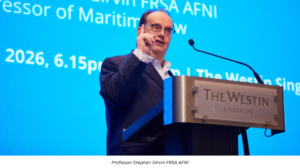
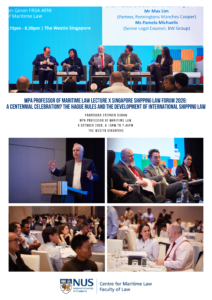
On 8 October 2026, the Centre for Maritime Law (CML) at NUS Law marked a special occasion with the ninth edition of its annual Singapore Shipping Law Forum, held in conjunction with the Inaugural MPA Professor of Maritime Law Lecture at The Westin Singapore. The combined event was attended by over 100 industry and legal professionals as well as alumni and featured a keynote lecture by Professor Stephen Girvin, MPA Professor of Maritime Law and Director of CML, titled ‘A Centennial Celebration? The Hague Rules and the Development of International Shipping Law’. In his welcome address, Professor Andrew Simester, Dean of NUS Law, underscored the importance of institutional partnerships in advancing legal research and expressed appreciation for the invaluable support of the Maritime and Port Authority of Singapore (MPA) and the Singapore Maritime Institute (SMI). MPA’s funding of the Professorship and SMI’s continued support of CML and its activities have been instrumental in strengthening the Centre’s research and engagement with the maritime law community. The event also featured a panel discussion with distinguished legal professionals from the maritime industry.
In his lecture, Professor Girvin explored the development of the Hague Rules and of international law governing the carriage of goods by sea. The speaker began by discussing the position before the adoption of the Hague Rules, the development of law restricting the carrier’s right to exclude liability in the USA, New Zealand, Australia and Canada, and emphasised that not everyone, notably Lord Justice Scrutton, was happy with the adoption of the Hague Rules into English law. Next, Professor Girvin discussed the development of the Hague Rules through the Visby Protocol 1968, the SDR Protocol 1979 and the attempts to introduce new regimes with the Hamburg Rules and the Rotterdam Rules. The speaker noted that it is difficult to say exactly how many countries have adopted the Hague or Hague-Visby Rules, as some, even though not parties to the Conventions, apply them under national law.
After covering the history of the Hague Rules, Professor Girvin moved on to their core provisions. He emphasised that, despite being more than 100 years old, the Hague Rules continue to develop through case law. On seaworthiness, he addressed the evolving understanding of this category in specific cases, such as The CMA CGM Libra (2021) and The Happy Aras (2026). Regarding the due care obligation, Professor Girvin discussed when the rule applies, citing Volcafe (2018) and mentioning Albacora SRL v Westcott & Laurence Line (1966). He emphasised the difficulties composite paramount clauses pose for interpretation. Particular attention was paid to The Happy Ranger (2002), The MSC Amsterdam (2007), The Superior Pescadores (2016), and The Dijksgracht (2023). The next points addressed by the speaker were the documentary coverage of the Hague Rules (The Rafaela S (2005)), limitation of liability, including in the context of containerisation (The Maersk Tangier (2018)), time bar and the nature of ‘suit’ (The Taikoo Brilliance (2026)), and misdelivery (The Giant Ace (2024)).
Next, Professor Girvin addressed the development of the Hague Rules in the twenty-first century, with particular attention to multimodal carriage and electronic bills of lading. He concluded that the Hague Rules continue to play a crucial role in governing the carriage of goods by sea, but their application and interpretation remain uneven.
The keynote address was followed by a panel discussion featuring Li Fangyi (General Counsel at Pacific International Lines (Pte) Ltd), Craig Johnston (Vice President, Global Claims Lead Cargo at Gard), Max Lim (Partner at Penningtons Manches Cooper), and Pamela Michaelis (Senior Legal Counsel at BW Group), who offered insights into the application of the Hague Rules in their areas of practice.