

Media - News
CML Seminar Series: Jurisdictional Challenges for Remote Operation Centres and Uncrewed Ships
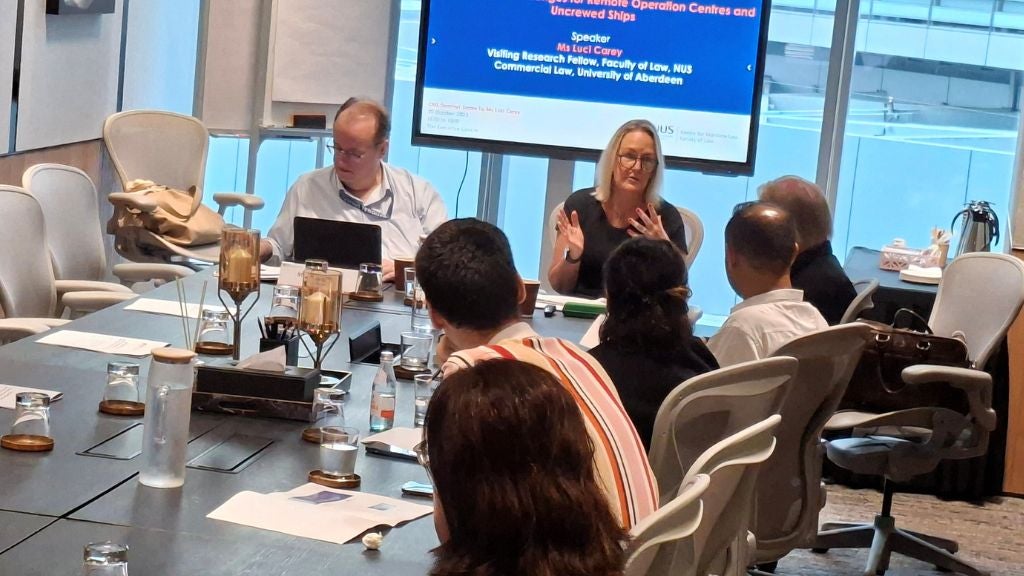
On 30 October 2025, the Centre for Maritime Law (CML) hosted a CML Seminar at the Ocean Financial Centre. As part of the event, Ms Lucy Carey, Adjunct Senior Research Fellow at the Centre for Maritime Law at NUS Law and Lecturer in Commercial Law at the University of Aberdeen, delivered a presentation on Jurisdictional Challenges for Remote Operation Centres and Uncrewed Ships.
Ms Carey addressed a wide range of legal and regulatory issues concerning unmanned and autonomous vessels. Her lecture explored topics such as the duties of flag states and the rights of coastal states, the legal status of unmanned vessels as ‘ships’, pilotage and cabotage implications, flags of convenience for Remote Operation Centres (ROCs), and private international law questions, including ship arrest.
The motivations driving the development of autonomous and unmanned vessels are diverse. These include safer voyages with lower emissions, reduced operational, voyage, and crew costs, the potential integration of Maritime Autonomous Surface Ships (MASS) into the Internet of Things within logistics and supply chains, and addressing the challenge of a shrinking global seafarer workforce. The International Maritime Organisation (IMO) has classified MASS into four levels of autonomy, from Degree 1 (ships with automated processes and decision support) to Degree 4 (fully autonomous ships). Ms Carey highlighted the ongoing regulatory efforts by various international bodies, emphasising that the IMO’s initiative to develop a non-mandatory, goal-based MASS Code remains the most significant step forward.
ROCs are particularly crucial for Degree 2 and Degree 3 automation levels. Ms Carey discussed the role of these centres and whether they could be considered ‘ships’ under traditional legal frameworks, referring to jurisdictional issues, the United Nations Convention on the Law of the Sea (UNCLOS), flag state responsibilities, coastal state rights, and limitations on port state control.
The discussion then turned to private international law considerations for autonomous ships. Ms Carey examined maritime conflict-of-law principles, including lex causae (the proper law), lex loci delicti commissi (the law of the place where the harmful act occurs), and lex loci damni (the law of the place where the damage occurs). She also referred to the 1952 Collision Convention and its implications for such vessels.
Regarding dispute resolution and ship arrest, Ms Carey compared Australian and Canadian case law, including The Seaeye Leopard [2020] [2020] FCA 273 and Cyber Sea Technologies Inc v Underwater Harvester Remotely Operated Vehicle [2003] FC 569. She further examined maritime claims arising from ownership and mortgages, shipping accidents, and commercial operations.
In conclusion, Ms Carey observed that unmanned ships present complex jurisdictional challenges. She accepted that Remotely Operated Vehicles (ROVs) can qualify as ‘ships’, and therefore may be subject to arrest. However, she clarified that ROCs cannot be regarded as part of a flag state. She concluded by emphasising that trust in both systems and users will be essential, noting that remote operations add a layer of complexity to maritime conflict-of-law issues.