

Media - News
CML Seminar Series: Charterers and Limitation
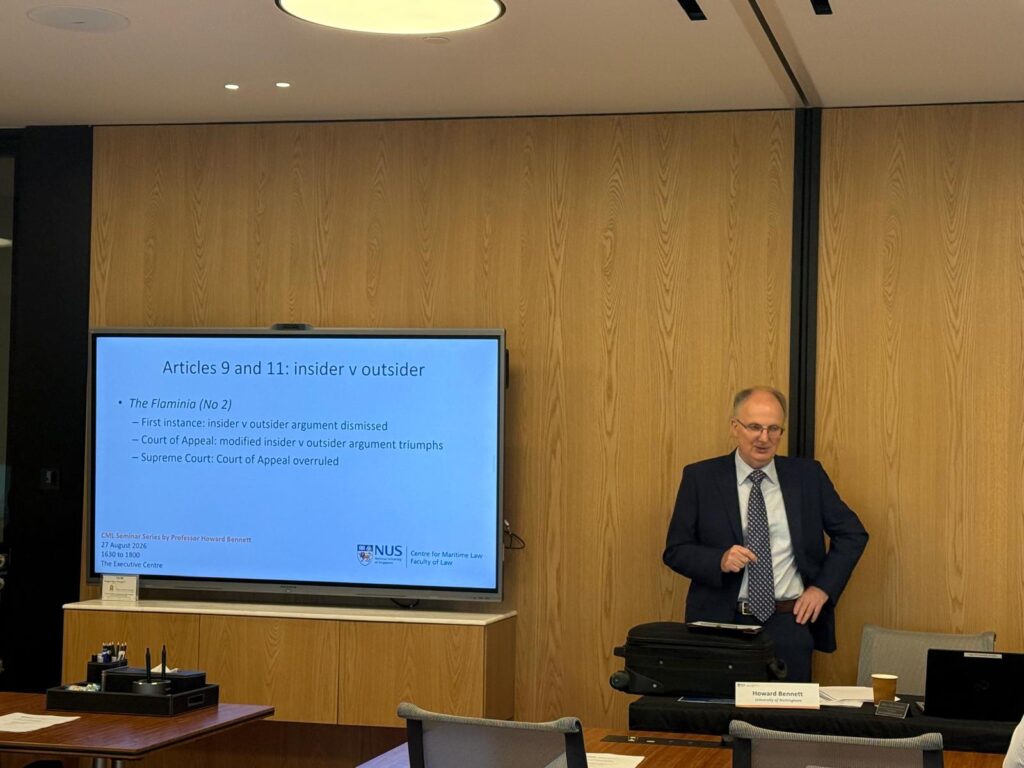
On 27 August 2026, the Centre for Maritime Law (CML) hosted a seminar titled ‘Charterers and Limitation’ at the Ocean Financial Centre. Professor Howard Bennett, Sat Pal Khattar Visiting Professor at NUS Law and Hind Professor of Commercial Law at the University of Nottingham, delivered the seminar.
Professor Bennett began by outlining the structure of the 1976 Convention on Limitation of Liability for Maritime Claims, which applies in both Singapore and the United Kingdom. Article 1 includes charterers, operators, and managers within the Convention’s definition of ‘shipowner’, while Article 2 identifies the claims subject to limitation. Article 6 sets the applicable liability limits, while Article 9 connects the parties identified in Article 1 to those limits, resulting in a single limitation amount for all limitable claims arising on a distinct occasion.
The presentation traced the historical extension of limitation beyond registered owners, beginning with The Hopper No 66, in which the House of Lords held that a demise charterer fell within the statutory meaning of ‘owner’ and could therefore invoke limitation. Professor Bennett then examined the modern English authorities on claims between parties falling within the Convention’s shipowner category. Four cases, producing seven judgments, have considered whether charterers may limit liability against owners for loss of or damage to the chartered vessel: The Aegean Sea, The CMA Djakarta, The Ocean Victory, and The Flaminia (No 2).
Under the settled English approach, a charterer is in principle entitled to invoke limitation. The decisive question is whether the particular claim falls within Article 2. A claim for loss of or damage to the chartered vessel itself is not limitable, while certain claims concerning other property, cargo removal, decontamination, or wreck removal may be limitable under other parts of Article 2, depending on any applicable reservation. Professor Bennett highlighted the difficulty of identifying a principled basis for this mixed outcome, under which different losses arising from the same casualty may receive different treatment.
The comparative discussion contrasted two approaches in Scandinavia. Norwegian law permits charterers to limit liability against owners, including liability for damage to the chartered vessel. Swedish law, by contrast, traditionally treats limitation as protection against liabilities arising in a vessel operator’s external relations and excludes losses concerning the vessel and property functionally forming part of it. Professor Bennett observed that English law lies between these approaches, but reaches its position through a close reading of the Convention rather than an articulated policy choice.
In conclusion, Professor Bennett referred to Lord Hamblen’s observation that the Convention ‘is what it is’. During the Q&A session, he clarified that he was not advocating the Norwegian position but suggested that maritime law would be better served by more directly considering what the answer ought to be. The discussion also addressed insider claims and their potential effect on the limitation fund available to third-party claimants.