

Media - News
CBFL Seminar: “Stablecoins, Digital Currencies, and the Quest for Global Money” by Professor Matthias Lehmann
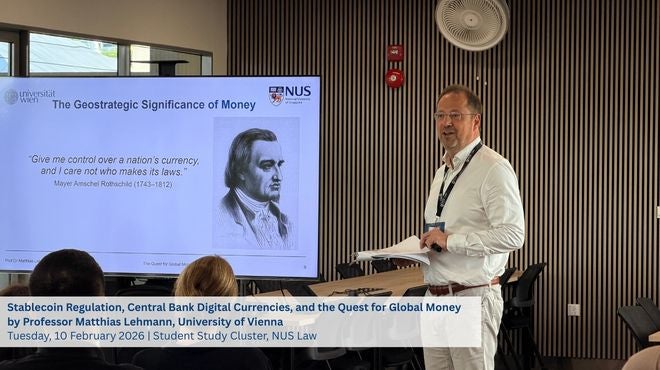
On 10 February 2026, the Centre for Banking and Finance Law hosted a seminar by the Peter Ellinger Visiting Professor, Professor Matthias Lehmann from the University of Vienna. Professor Lehmann’s topic was “Stablecoins, Digital Currencies, and the Quest for Global Money”.
Professor Lehmann began by introducing the digital money revolution in the payment sector. He outlined the differences between stablecoins and central bank digital currencies (CBDC) in terms of issuer, underlying technology, reference asset, interoperability, and programmability. He then elaborated on the regulatory competition for money and the definition of money from both social and legal perspectives. Professor Lehmann then raised the question of whether stablecoins are used as money. He noted that stablecoins can serve as a means of payment for other crypto assets or as a possible settlement currency for tokenized securities, but are barely used in day-to-day transactions in the real world.
Professor Lehmann examined a range of emerging rules for stablecoins in the US, the EU, and Singapore. He compared the GENIUS Act (US), the Markets in Crypto-Assets Regulation (EU), and the MAS’s stablecoin regulatory framework (Singapore) in terms of requirements regarding regulatory scope, issuers, reference currency, reserve assets, asset segregation, insolvency protection, redemption right, and interest payment. Professor Lehmann also explained driving factors and related concerns in the development of CBDCs.
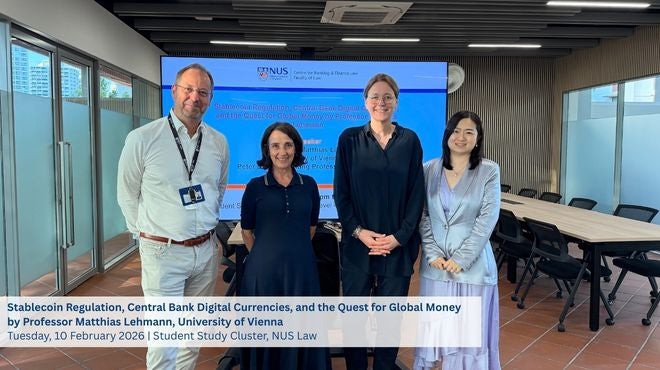
On a final point, Professor Lehmann considered whether stablecoins or CBDCs could be global money. Through an in-depth analysis of the benefits and downsides of global money, he pointed out that stablecoins can serve as a bridge between fiat currency and private money but they also present problems, such as being impractical for daily payments, lacking legal tender status, and having a fragmented regulatory framework. By comparison, CBDCs can be the future of fiat money; however, they are primarily designed for domestic payments and face interoperability issues when used across borders. Professor Lehmann explored the essential characteristics of a monetary asset from an economic perspective, such as being durable, portable, divisible, uniform, limited in supply, and accepted. He concluded that neither stablecoins nor CBDCs are likely to become the dominant global payment method at present and, instead, competition between different currencies will continue, especially in an uncertain geopolitical environment.
 |
 |