
Media - News
CBFL Seminar Series: Everything You Ever Wanted to Know about U.S. Sanctions…But Were Afraid to Ask
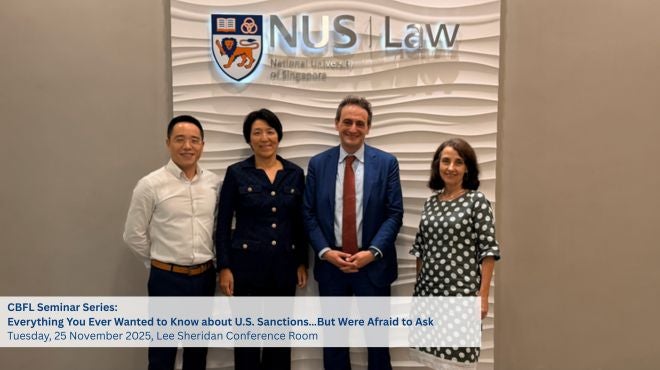
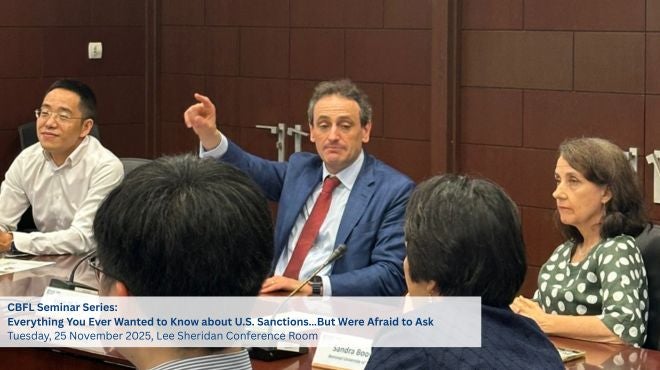
The Centre for Banking & Finance Law was pleased to host a seminar on sanctions by Mr. Adam Smith, Partner and Co-Chair of the International Trade Advisory & Enforcement Group at Gibson, Dunn & Crutcher. As a former Senior Advisor to the Director of the Office of Foreign Assets Control (OFCA) and Director for Multilateral Affairs on the National Security Council (White House), Mr. Smith has extensive experience in international trade compliance, including federal and state economic sanctions enforcement, tariffs, and export and import controls.
Mr. Smith began with an overview of the rise of US sanctions. He pointed out that sanctions were vilified, misunderstood, and comparatively rare in the mid-1990s, but they became the tool of choice to address a growing number and diversity of policy challenges by 2010. Mr Smith used several charts to demonstrate that the US continues to rely on economic sanctions as a primary tool of diplomacy and national security, and that new sanctions programs have been instituted quickly.
Mr. Smith outlined three types of sanctions: primary sanctions, enforcement, and secondary sanctions. Primary sanctions can be classified as jurisdiction-based and secondary sanctions as behavior-based; enforcement may result in civil and criminal consequences as well as export restrictions. Mr. Smith explored how and why sanctions work by denying access to all property and assets held in the US, US financial, commercial and consumer markets, and US dollar clearing for global transactions. He also mentioned several other “sanctions-like” policy tools, including export controls, tariffs, import controls, foreign direct investment controls, and outbound controls.
Mr Smith noted the large number of executive orders issued in 2025 by the US President to direct federal agencies and officials in their execution of congressionally established laws and policies. Executive orders are legally binding and immediately effective, the statutory basis for which has been the International Emergency Economic Powers Act (IEEPA). The reasons for using executive orders are their speed and ease (no limits), flexibility (unfettered discretion to impose restrictions), and near-zero cost. Mr. Smith elaborated how the widespread use of executive orders has raised emerging legal and practical challenges. From a legal perspective, it remains uncertain whether the unprecedented use of IEEPA can withstand judicial scrutiny. For instance, the absence of due process associated with the immediate imposition of restrictions may run counter to Constitutional protections. In practice, the main challenge is how to navigate diverging global trade regimes, both within the US and between the US and other jurisdictions. Mr. Smith highlighted the downsides of sanctions, citing Russia as an example, including how the uncertainty in future policy restrictions may cause many firms to avoid long-term investment in a previously sanctioned area and decline to return to these areas.