

Media - News
Regulating Powerful Businesses: Regulation by Intentional Institutionalism
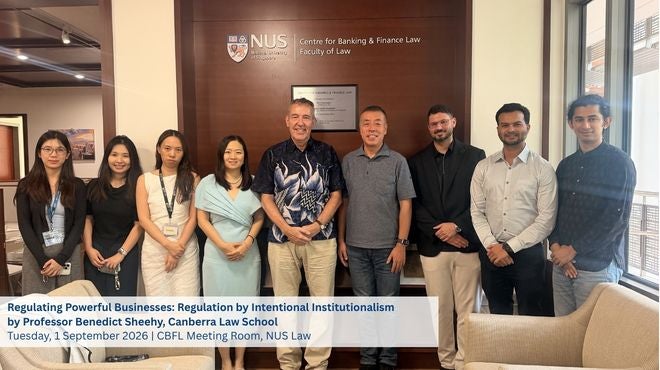
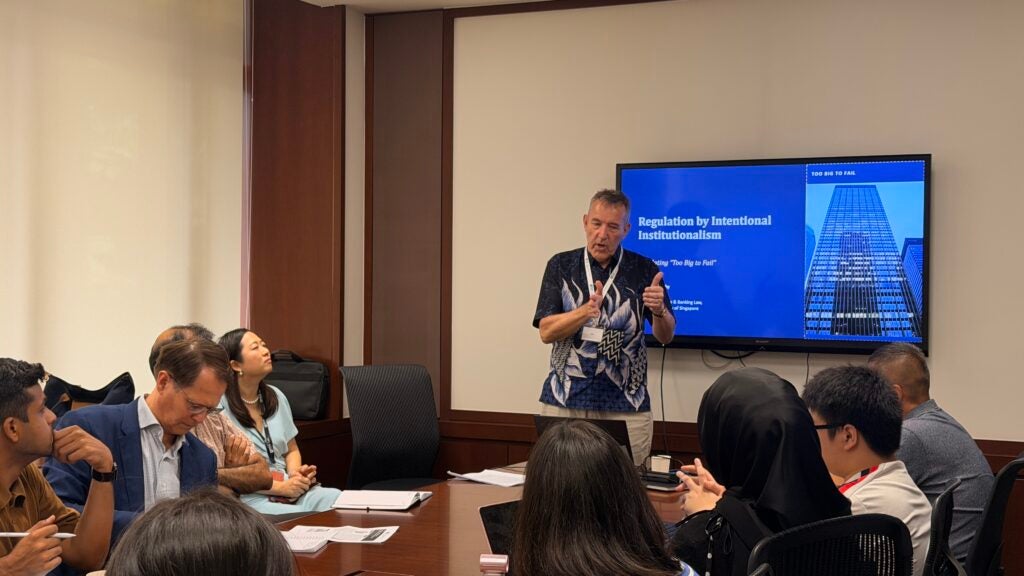
On 1 September 2026, the Centre for Banking and Finance Law hosted a seminar by Professor Benedict Sheehy from Canberra Law School. Professor Sheehy’s topic was “Regulating Powerful Businesses: Regulation by Intentional Institutionalism”.
Prof Sheehy began by noting that current regulatory approaches are not effective at policing the conduct of large, systemically important actors. His research highlights HSBC’s $1.9 billion fine for anti-money laundering violations in 2012 as a cautionary tale. Although regulators installed a compliance monitor and the bank appeared to reform, it later emerged that misconduct had continued under the nose of the compliance monitor. Public inquiries into HSBC, Wells Fargo and Australia’s Commonwealth Bank each reached the same conclusion: the root cause was a rotten corporate culture.
Drawing on social science research, Prof Sheehy conceptualises law as a social institution interacting with the rest of society, and treats large financial organisations as the clearest examples of “systemic actors.” He described a “hamster wheel” of reform, in which major misconduct triggers a public inquiry, culture is blamed, old instruments are recycled, and “compliance theatre” follows, until the next scandal erupts. Regulators have already tried targeting compliance structures, the corporation itself through fines, and individual “bad apples” through CEO resignations. Prof Sheehy argued that none of these approaches has affected culture.
The two leading theories of regulation are ill-suited to giant institutions. Responsive regulation assumes the regulated party is vulnerable, morally persuadable and outmatched by a more powerful regulator. These assumptions do not hold for systemic actors. Meta-regulation, which relies on firms building their own values-based systems, is said to work poorly at scale and to leave culture untouched. Additionally, Prof Sheehy cited organisational research identifying five corporate responses (acquiescence, compromise, avoidance, defiance and manipulation) and noted that existing theories address only the first two, while large firms typically resort to the other three.
For these reasons, Prof Sheehy proposed “Regulation by Intentional Institutionalism” (RBII). This model would retain existing methods for smaller firms; for systemic actors, it would focus on the leadership cadre – defined as anyone who shapes decision-making premises, regardless of job title – and make removal from office the primary tool. Its sequence of path disruption, normative instability and normative reconstruction is intended to reshape institutions themselves. Prof Sheehy observed that De Nederlandsche Bank, the Dutch central bank, already operates a comparable model.
Prof Sheehy drew a distinction between deep, slow-changing organisational culture and the more malleable “climate”, which relates to employees’ perception of what behaviour is rewarded. Because climate feeds culture, the only way to influence an organisation’s underlying assumptions is by influencing the actual conduct of its leadership. The ultimate goal of RBII would be to change “institutions”, i.e. the ways of doing business.
A brief but lively discussion followed the presentation. Prof Sheehy addressed a range of questions and comments, including in relation to internal conflicts within an organisation, the potential impact of AI on corporate culture, how RBII could apply to organisations with charismatic leaders, and the broader appeal of reductionist models of decision-making.
 |
 |