

Media - News
The APAC Stablecoin Playbook by Dr Lisa-Marie Ross, Flint Global
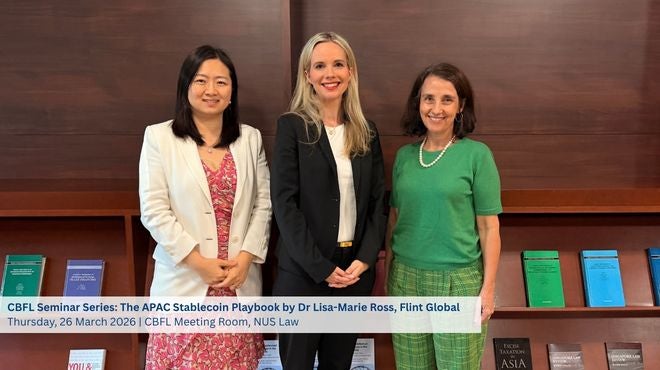
On 26 March 2026, the Centre for Banking and Finance Law (CBFL) hosted a seminar by Dr. Lisa-Marie Ross, Director at Flint Global and Visiting Scholar at CBFL. Dr. Ross’ presentation, “The APAC Stablecoin Playbook”, examined how digital money is being operationalised across Asia-Pacific.
Dr. Ross opened by noting that while stablecoins are rapidly being integrated into financial systems across the region, this process is inherently fragmented rather than convergent. What is underway is a structural shift: from crypto as a speculative asset class to digital money as financial infrastructure. Each jurisdiction is pursuing its own regulatory and operational model, shaped by domestic priorities and broader economic strategy. Markets differ in their definitions, taxation, and oversight approaches.
Across Asia-Pacific, jurisdictions are pursuing distinct regulatory and institutional approaches, reflecting domestic priorities and broader economic strategy. Markets differ in their definitions, taxation, and oversight approaches.
Australia approaches digital money through payments system modernisation, applying a functional, use-case driven regulatory lens. Singapore has established a regulated but innovation-oriented framework, positioning itself as an institutional hub. Hong Kong is moving into controlled implementation, with a tightly gated licensing regime limited to a small number of approved issuers. Japan appears to be taking a more conservative turn, with proposals to reclassify crypto-assets under securities regulation. Korea and Taiwan remain in the design phase, with key policy questions centred on issuance and capital controls. China, by contrast, continues to advance a state-led model centred on its CBDC, while maintaining strict limits on private alternatives.
Stablecoins are already being deployed in cross-border payments, treasury operations, and capital markets activity, including tokenised bond issuance. However, their effectiveness is constrained by structural fragmentation. A stablecoin compliant in one jurisdiction may not be recognised in another, while tokenised assets may face settlement frictions across markets.
These frictions are not incidental. They arise from differences in licensing regimes, issuer models, and capital controls. Because digital money is often viewed through a macroeconomic lens (especially regarding cross-border flows) many jurisdictions prioritise sovereignty over interoperability. The result is not convergence, but the emergence of corridor-based systems, where connectivity is selective and shaped by regulatory alignment rather than technical capability.
The discussion also highlighted the emergence of a multi-layered “stack” of digital money. At its foundation sits central bank money, providing finality and systemic trust. Above this are tokenised bank deposits, supporting intermediation and credit creation. At the top layer are stablecoins, enabling programmability and integration into digital transaction environments.
While this layered system can function within domestic markets, extending it across borders introduces complexity. Interoperability depends not only on technology, but on regulatory alignment across markets. Without this, friction emerges between layers, particularly in cross-border transactions.
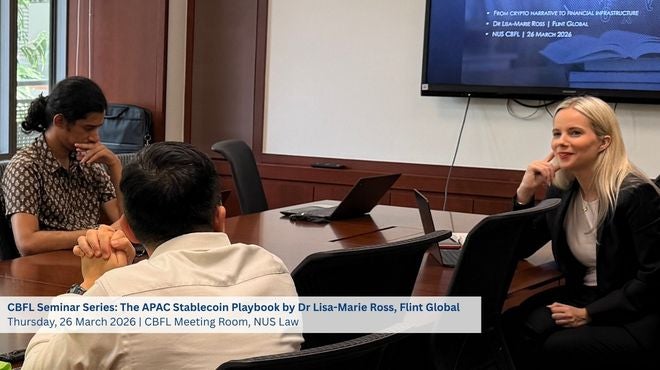
Crucially, the choice of who is permitted to issue stablecoins is not simply a regulatory detail. It is a structural decision that shapes market outcomes. Restricting issuance to banks reinforces existing financial intermediation models, while allowing non-bank issuers introduces new forms of competition. Highly selective licensing regimes, in turn, concentrate activity among a small number of participants. In this sense, digital money is not only being regulated, it is being used to reshape market structure.
Dr. Ross concluded by emphasising that the evolution of digital money is fundamentally about control. As money becomes programmable and embedded into financial infrastructure, access is increasingly determined by regulatory design rather than market participation. While the global debate is often framed as a choice between CBDCs and stablecoins, the reality in Asia-Pacific is more complex. Different systems are being built in parallel, reflecting divergent policy choices about the role of the state, the scope for private innovation, and the management of financial risk. Ultimately, this is not about whether digital money will exist, but about what kind of system is being constructed, and who controls access to it. In that context, fragmentation is not a temporary inefficiency. It is a deliberate policy outcome, with long-term implications for how financial markets are accessed, structured, and governed.