


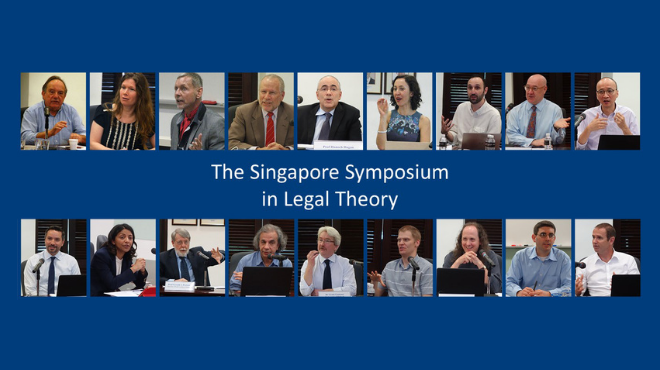

“A Theory of European Private Law Adjudication”
by Professor Chantal Mak, University of Amsterdam

“Normative Powers, Conventional and Nonconventional Consent”
by Jesse Wall, University of Auckland
Highlights
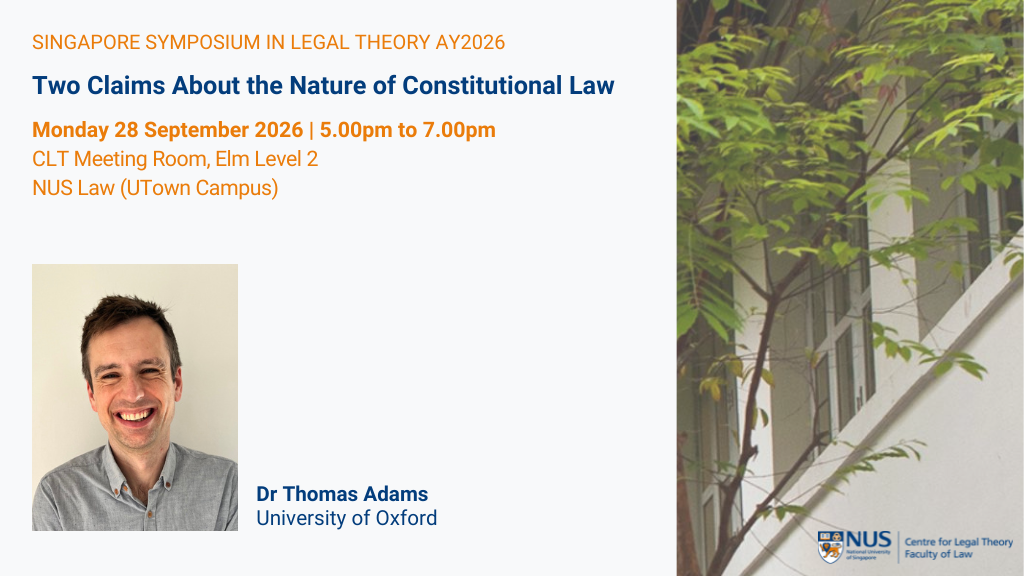
The Singapore Symposium in Legal Theory AY2026 "Two Claims About the Nature of Constitutional Law" by Dr Thomas Adams, University of Oxford
Legal theorists have long been interested in the question of constitutional interpretation, but there is very little philosophical work on the nature of constitutional law. For example, what is its subject matter? What identifies a norm as a norm of constitutional law? Drawing on the work of the late John Gardner, I defend two claims. First, that constitutional law has as its object bodies whose authority is, in a sense I go on to describe and defend, fundamental. Second, that the function of constitutional law is to regulate the exercise of power by such bodies.
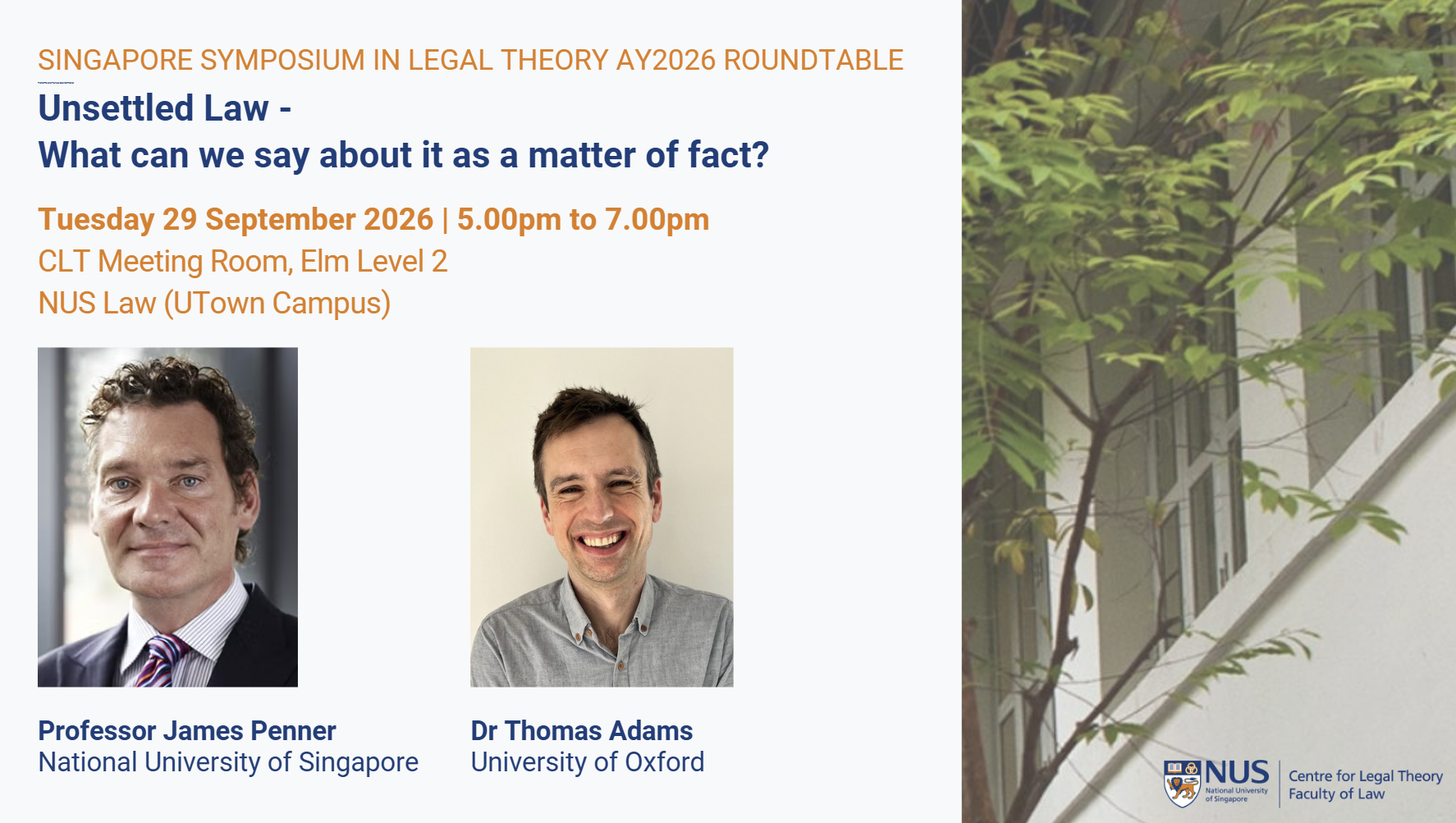
The Singapore Symposium in Legal Theory Roundtable AY2026 “Unsettled Law - What can we say about it as a matter of fact?” by Professor James Penner, National University of Singapore and Dr Thomas Adams, University of Oxford
Lawyers commonly speak of ‘unsettled law’, but it is not clear that the concept has been sufficiently analysed. It is the purpose of this paper to outline how that analysis might go. First, the paper examines the basic nature and different sources of unsettled law. It then considers Dworkin’s ‘one right answer thesis’ to see how, if at all, it should shape our understanding of unsettled law. It then draws upon David Lewis’s ‘Truth in Fiction’ to consider the nature of the statements we make about unsettled law, and finally the paper turns to how we should understand what might be called ‘future facts’ about the law when we look forward to a point of law’s being settled by a court.
The Singapore Symposium in Legal Theory AY2026 Roundtable “Platforms for Political Disinformation: Principled Criminal Liability for Posting and Hosting” by Professor Jeremy Horder, London School of Economics and Asst Prof Benny Tan, National University of Singapore
The history of criminal law scholarship is largely the history of the struggle to develop a more principled (and humane) approach to the criminalization of individuals; but in course of that struggle, the meaning and significance
of key criminal concepts, as well as the understanding of what is historically and morally significant about the criminal law, has come to be understood as almost wholly in individualized terms. In that regard, a larger project I have in mind will involve an argument that membership of the EU between 1972 and 2020 had a profound and far-reaching effect on criminalization in the UK that had gone largely unnoticed, because it affected mainly (small) companies, even though it had very real implications for the individuals running those companies.
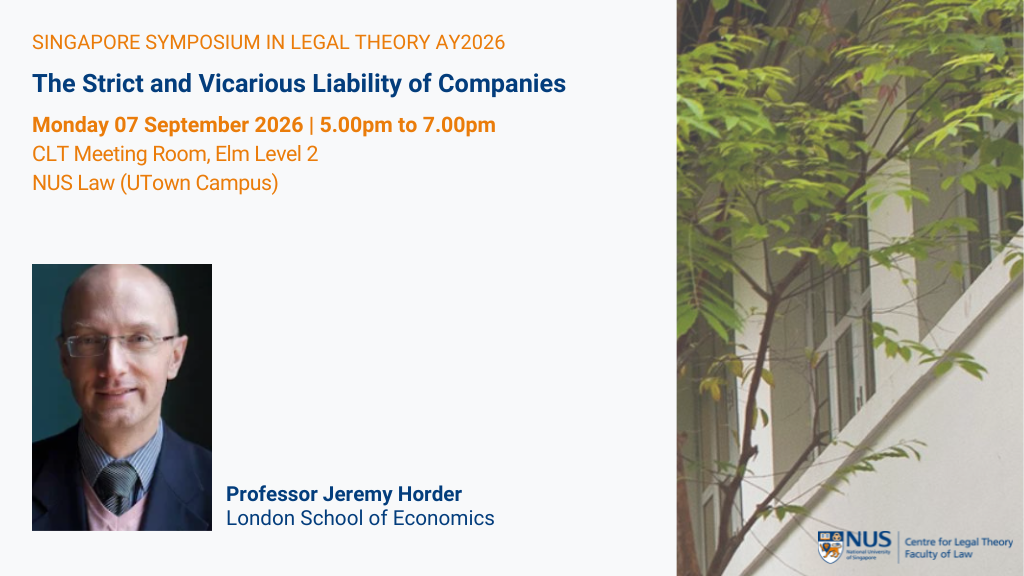

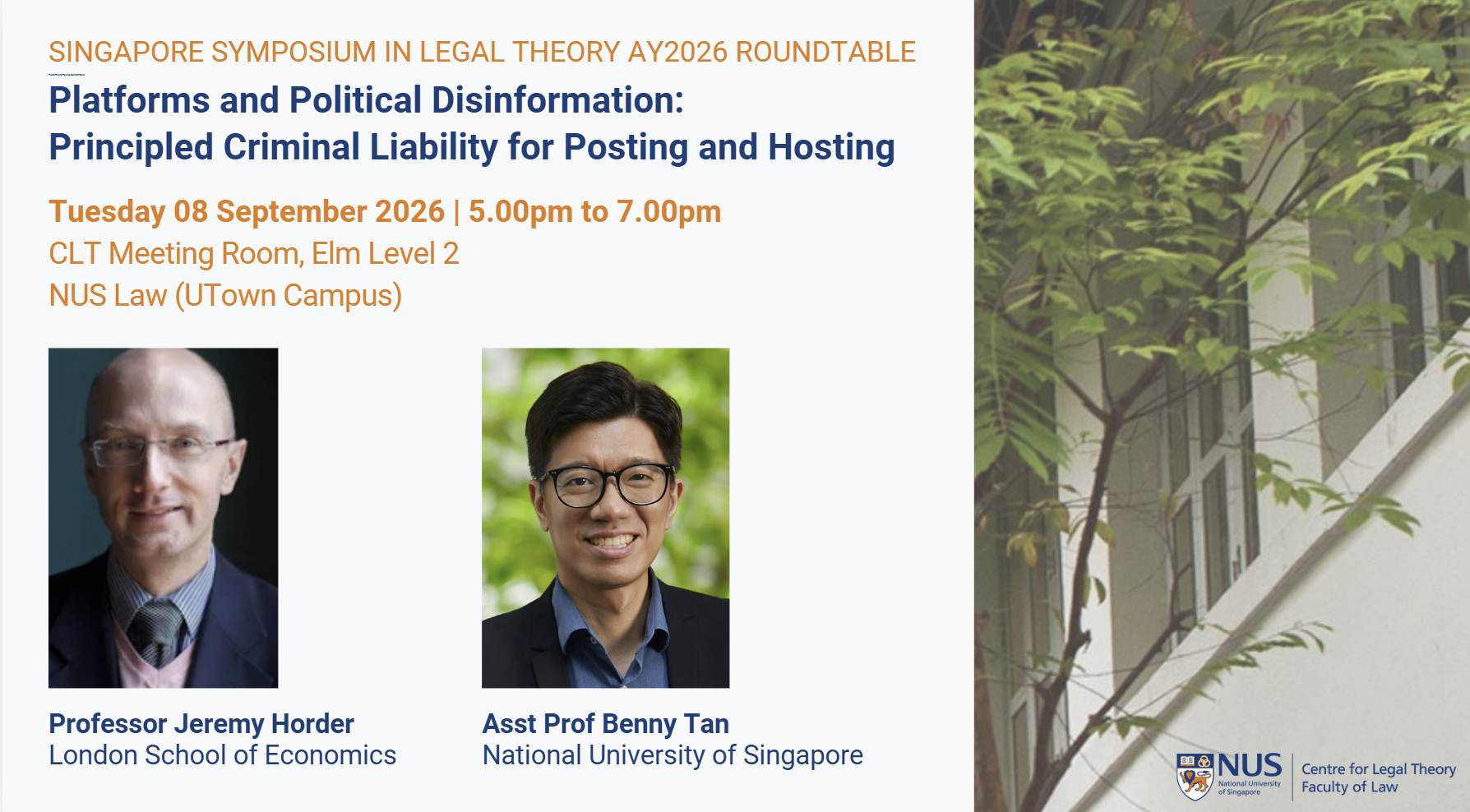
The Singapore Symposium in Legal Theory AY2026 Roundtable “Platforms for Political Disinformation: Principled Criminal Liability for Posting and Hosting” by Professor Jeremy Horder, London School of Economics and Asst Prof Benny Tan, National University of Singapore
It is a well-understood feature of an ethically and politically sound criminal law that any criminalisation is capable of justification not (or not merely) in terms of wrongfulness but in terms of the harm principle. That is as true when the focus of criminalisation is speech as when the focus is action. Equally well-understood is the proposition that, even when criminalisation of conduct is capable of justification in terms of the harm principle, it may nonetheless be wrong to criminalise. That may be true if, for example, there are strong countervailing public policy considerations, or there are adequate alternative (non-criminal) ways of dealing with the conduct in question.