

Media - News
SSLT 2025: Currents in Contemporary Contract Law Theory
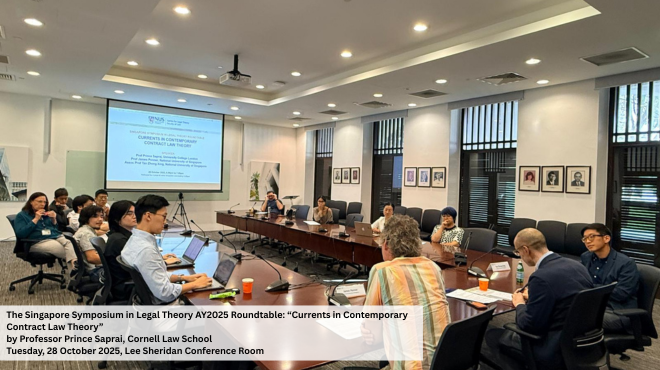
At the Singapore Symposium in Legal Theory Roundtable held on 28 October 2025 at the National University of Singapore, Professors Prince Saprai, James Penner, and Associate Professor Tan Zhong Xing convened to examine the evolving landscape of contemporary contract law theory. Over the past few decades, contract theory has undergone a profound transformation—from its traditional focus on the dichotomy between “will” theorists and their critics to a rich plurality of normative frameworks, methodological approaches, and perspectives on obligation, morality, and justice in private law.
Prince illuminated how modern contract law increasingly engages philosophical debates about transnational private law, the ethics of markets, and the moral foundations of consent, extending his influential scholarship on Philosophical Foundations of Contract Law and Contract Law Without Foundations.
James expanded the discussion by situating contract within the broader architecture of private law, drawing on his expertise in the philosophy of property and the law of trusts to interrogate the relationship between promise, autonomy, and legal enforcement. Zhong Xing contributed a distinct perspective grounded in commercial and comparative private law, emphasising the intersection of doctrinal coherence and theoretical pluralism in modern contract scholarship. Together, the panellists traced how contemporary theorists navigate tensions between autonomy and fairness, description and evaluation, and doctrinal analysis and empirical insight. Their exchange underscored that contract law is no longer confined to the enforcement of private promises but has become a dynamic site for contesting values of obligation, cooperation, and justice within a global legal order. The roundtable thus captured a moment of intellectual convergence in contract theory—where classical debates give way to pluralist frameworks that better reflect the complexities of modern legal and moral life.