

Media - News
Student Kamal Ashraf takes the stage at Ministry of Law Convention
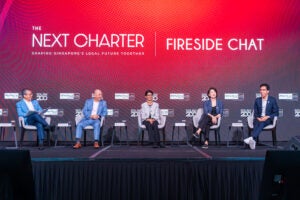
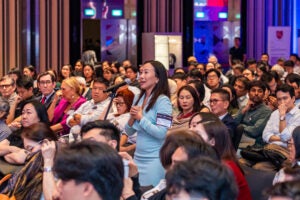
An overwhelming crowd of 900 legal practitioners, students and tech leaders. An electric atmosphere. On 6 March 2026, the Fairmont Ballroom at Raffles City Convention Centre was transformed into a centre of dialogue and digital discovery for the event The Next Charter: Shaping Singapore’s Legal Future Together. Marking a crossroads in the bicentennial year of Singapore’s legal and judicial system, Law Minister Edwin Tong S.C.’ 94 bridged the past and present with his vision of a high-tech future in his keynote speech. Offstage, showcase booths demonstrated advanced technologies already being deployed across industries, not just within the legal field.
As Mr Tong moved on to moderating a fireside chat with industry leaders, one voice stood out. Our final year undergraduate, Kamal Ashraf Bin Kamil Jumat ’26, was the lone student on the panel, and was part of the conversation exploring how AI and emerging technologies may shape the practice of law in the years to come. Kamal capably represented his peers as he shared the next generation’s perspectives and fears of the rapidly changing tech-legal landscape.
The Next Quantum Leap
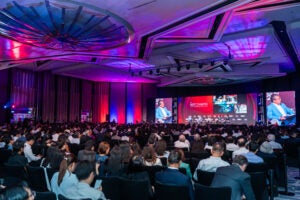
Mr Tong, who is also the Second Minister for Health, delivered a powerful keynote speech that struck a balance between urgency and ambition. Reflecting on his early days in practice—complete with telex machines, paginators, and the “game-changing” arrival of the Blackberry—he highlighted the blistering pace of modern change.
He noted that while technology once took a decade to reach a million users, ChatGPT did it in five days. His message to the room was sharp and pithy: “The human who adopts AI better will replace the human who does not.”
“Preserving inefficiencies just to preserve work is not sustainable. Clients will inevitably demand better… We either move up the value chain, or we will be overtaken,” he said, as he declared the ministry’s full support for the adoption of AI.

To that end, two major announcements on transitioning tools were made: the LIFT (Legal Innovation and Future-Readiness Transformation) Initiative and the GenAI Guide. LIFT is a comprehensive support system for change management, partnering firms with experts to overhaul their back-end and front-end processes, while the Guide would set the parameters for using Generative AI safely and responsibly in legal practice, without “hard-coding” rigid rules that might stifle innovation.
AI in School
What should a law degree teach then? Mr Tong posed the question, stating that the answer cannot simply be “how to use AI tools”.
“This means training lawyers to develop ethical reasoning, empathetic client engagement, judgment in situations of real ambiguity and, sometimes, the moral courage to tell a client something they do not want to hear,” said Mr Tong, declaring that the issue would be examined closely by the Future of Legal Profession Committee, in collaboration with the broader legal profession.
In Conversation
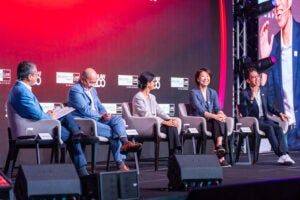
The centrepiece of the event was a dynamic fireside chat featuring panellists from outside the legal profession, including Mr Yuen Kuan Moon (Group CEO, Singtel), Ms Vaishali Rastogi (Global Leader for Technology, Media and Telecommunications Practice, Boston Consulting Group) and Ms Esther Lim (Director of SEAS Legal, Google). They provided perspectives on how emerging trends and challenges in the tech space impact the legal industry, how other industries have managed AI-driven transformation, and what law firms might learn from them.
Sitting alongside these heavyweights was Kamal, who provided a unique lens on how the next generation of the legal fraternity views the intersection between AI and law. Here, he shares his thoughts on representing the student body on such a prestigious stage.
Kamal’s Front-row Perspective
“The only thing I’ve spent the last 24 years doing is being alive.”
When asked by Mr Tong about how it felt being on the same panel as the other top executives, that was my immediate response. Chuckles from the crowd followed.
I continued my response by stating what I hoped to gain from the panel: to share my views as a law student and aspiring professional, while learning from industry leaders who had been in the game since before I was born. I knew that while I could not provide C-suite level analysis, I could still offer insights into how Gen Z students and professionals feel about the industrial revolution brought about by AI.
To start, I mentioned that Gen Z thinks different, acts different and dreams different, relative to other generations but also relative to one another within the generation. As such, concerns over the rise of AI are difficult to generalise across an entire age group. However, I proposed a hypothesis: The more human-centric one’s intended area of practice tends to be (such as family law), the level of anxiety one has over AI “taking over” tends to be less severe.
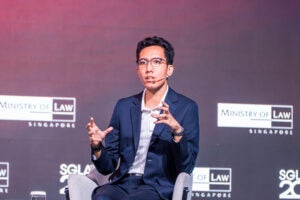
When asked about what the future of legal training could and should look like, I proposed an analogy to professional pilots. While everyday commercial flights tend to make use of automated systems, every pilot must attend flight school and learn manual skills. Likewise, while automation may help lawyers who are seasoned, legal training should involve some level of traditional skills training such as drafting and research. However, AI should be allowed and trained incrementally, as it continues to shape the everyday tasks of a lawyer.
My time at NUS has shaped my views on legal tech and AI quite considerably. I was part of the first batch to have Law and Technology as a compulsory course. While definitely not a universally loved subject (are there any?), I found learning how to code quite interesting. It motivated me to take Law and Natural Language Processing, an elective taught by Dr Ilya Akdemir that teaches students to apply code to the unpacking of legal text. My experience representing the university at the World Universities Public Speaking Invitational Championship in Macau in 2025 did help with engaging the crowd and answering questions, but the sheer scale and importance of the event did lead to some nerves at the start.
The convention itself was breathtaking. While four-legged robots walked around the centre much to our fascination, I listened in to presenters demonstrating the latest in legal research and drafting tools. These tools were developing rapidly; what used to be prototypes mentioned in a Law Tech lecture were now products on the market.
Reflecting upon my experience at The Next Charter, and indeed my four years spent at NUS Law, I remain cautiously optimistic that the future of the legal industry is bright, as long as the heart and humanity of the lawyer remains the apex court of the industry’s moral compass.

As Singapore looks towards the next century of its legal journey, Kamal’s thoughts reflect the message reinforced at the convention—that a commitment to the Rule of Law and service to the community remains the industry’s North Star.