

Media - Global News
Professor Devika Hovell delivers Kwa Geok Choo Distinguished Visitors Lecture
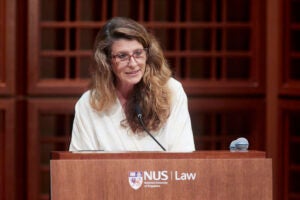
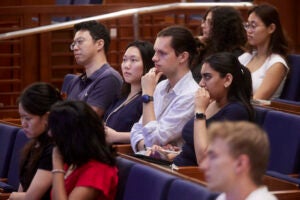
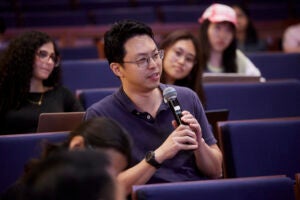
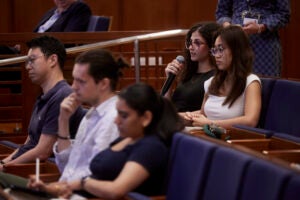
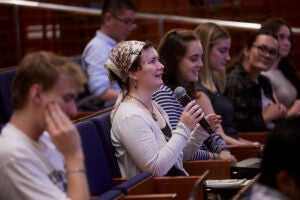
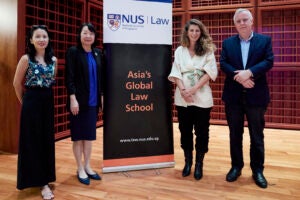
On 27 August 2026, Professor Devika Hovell delivered a lecture titled “The Constitutional Status of the Bomb” at NUS Law.
Nuclear disarmament is one of those phrases that can still sound faintly ridiculous—until it is used to justify a bombing campaign. Treated one moment as the residue of a naive politics of peace, and the next as the legal-political rationale for disciplining dangerous states, nuclear disarmament has acquired two public faces: sentimental and muscular. The trouble is that neither captures its real significance.
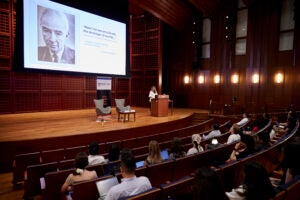
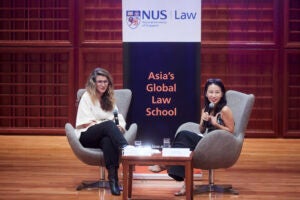
The lecture reflected on the idea of the bomb as a constitutional artefact: not simply a weapon of unique destructive force, but one that has helped to structure world order. Professor Hovell argued that the status of nuclear weapons has been sustained through two dominant routes of justification. The first shelters the bomb under the grammar of self-defence and protects it as a sovereign right. The second defers to the logic of deterrence, recognising the bomb as a form of strategic control. In different ways, both routes embed nuclear weapons within the structures of legal and political authority.
Against both fatalism and nostalgia, the lecture revisited these justifications through legal and political theories of authority, fear, non-domination and public reason. It asked how nuclear weapons shape the conditions of constitutional order, what forms of domination they sustain, and why disarmament should be understood not as utopian aspiration, but as a constitutional imperative.
The Kwa Geok Choo Distinguished Visitors Programme was launched in 2012 as one of several initiatives to pay tribute to the late Madam Kwa Geok Choo, wife of Singapore’s founding Prime Minister, the late Mr Lee Kuan Yew.
Since its launch, the Programme has enabled NUS Law to regularly bring in leading law academics to teach an intensive course and to share their perspectives on highly topical issues with our students, faculty and the wider legal fraternity. This Programme serves to uphold Madam Kwa’s remarkable legacy, by continuing her commitment to Singapore being an outward-looking country with a thriving legal discourse.
Past Distinguished Visitors include the following professors from esteemed institutions around the world: Gary Born (Partner, and Chair of the International Arbitration Practice Group, at Wilmer Cutler Pickering Hale), Christine Chinkin (London School of Economics and Political Science), Jane Ginsburg (Columbia Law School), Matthew Harding (Melbourne Law School), the late Ran Hirschl (University of Toronto), Michael Klausner (Stanford Law School), Peter Mirfield (University of Oxford), Donal Nolan (University of Oxford), Francis Reynolds (University of Oxford), Cheryl Saunders (Melbourne Law School) and Mark Tushnet (Harvard Law School).
Most recently, the 24th and 25th Kwa Geok Choo Distinguished Visitors Lectures were delivered by Professor Ying Khai Liew & Professor Norman Ho.
The lectures given will also be published in the Singapore Journal of Legal Studies.
About Professor Devika Hovell
Professor Devika Hovell is Professor of Public International Law at the London School of Economics. She serves on the Editorial Board of the European Journal of International Law and is one of the Editors of the international law blog EJIL:Talk. She is a member of Matrix Chambers in London. Her current book project examines the future of collective security.