

Media - News
Eleanor Wong: From Jessup champion to mentor

Elation. Pride. Associate Professor Eleanor Wong ‘85 ran across the Hyatt Regency Ballroom in Washington D.C., to celebrate with NUS Law mooters Phoebe Chan, Tan Kai Han, Lee Dawn Gene, Natalie Koh and Caleb Tan. Moments earlier, Professor James Anaya, one of the three judges for the championship round, had announced that the NUS Law team had won the 67th Philip C. Jessup International Law Moot Court Competition 2026.
Forty-one years ago, at the Roosevelt Hotel in New York, on 27 April 1985, a younger Eleanor was on the other side of the same moment: Her team had just been crowned champion, with her named Best Oralist of the championship round.
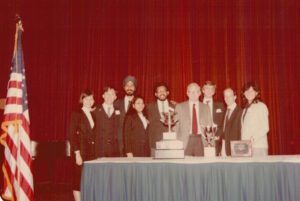
“We were not viewed as ‘most likely to succeed’, especially after the 1982 Dream Team won Singapore’s first Jessup. But we went on to win the International Finals against a team who had two top-ranked speakers and also beat the top American team to emerge overall champions!” Assoc Prof Wong recalled.
Discovering Her Voice at 10
Assoc Prof Wong’s love for the “intellectual discipline of finding arguments on the other side”, as she shared in an August 2006 interview with TODAY, could be traced to her formative years in Australia. At 10, she discovered her voice through writing, developing an interest in social and political issues such as the Cold War and the Vietnam War. That voice gradually found its way into debating, through competitions representing Methodist Girls’ School, Anglo-Chinese Junior College and NUS.
Her voice would continue to evolve across an unusually colourful career—from prosecuting high-profile cases as a Deputy Public Prosecutor and practising corporate finance law to working in television, chairing the SIA-JC debates and hosting After Hours, a current affairs show. She would also become known as an award-winning playwright and poet.
Mooter Becomes Mentor
In 2002, she returned to NUS Law to launch its new Legal Skills Programme and soon also found herself reconnecting with the faculty’s mooting culture. Over the years, she has mentored many generations of mooters alongside colleagues including Emeritus Professor Robert Beckman, who had coached her for the 1985 Jessup.
As course convenor for International Legal Processes and co-ordinator of the International Moot Programme, Assoc Prof Wong works with a team of coaches to guide students through weeks of intensive preparation for competitions.
For her, one of the greatest rewards of mentoring is being part of a student’s learning journey: helping them find their voice, overcome obstacles and realise their potential.
“I love being there at a moment when a student reaches a point of understanding and overcomes something that has been standing in the way of their growth,” she said.
The mooting landscape has changed considerably since she competed in 1985. That year, 213 teams participated in Jessup, with 36 reaching the international rounds. In 2026, the numbers had grown to 731 participating teams and 164 reaching the international rounds. The expansion of domestic and international competitions has also broadened the opportunities for students to hone their advocacy skills, even as the standard of competition has risen.
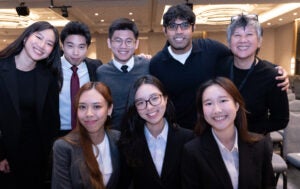
“I don’t know whether the callow young me would have had any chance of standing in a final,” she mused. “I’m rather grateful I didn’t see too much of myself in our wonderful team—they would probably not have done quite so well!”
An Imperfect Simulation of True Advocacy
Yet for Assoc Prof Wong, excelling at mooting is not about winning. As competitions grow more intense, she cautions, the pursuit of victory can distract students from what mooting is meant to teach: the purpose of advocacy itself.
“When every team is so well-prepared, so talented, one’s focus might shift from the core of advocacy to ‘gaming the game’,” she explained. “Instead, what ought to guide us is the understanding that mooting is just a simulation (and an imperfect simulation) of true advocacy.”
For her, the value of mooting lies in learning to put legal knowledge into practice: making substantive, ethical and responsible arguments and helping the court arrive at a fair, principled outcome. These lessons extend beyond competition, reflecting the qualities she believes make a good lawyer.
“The heart of what we do as lawyers is to serve others; that means being competent, responsible, reliable. All somewhat boring, but crucial qualities. To be consistently good at drawing attention to your client’s interests, without necessarily evoking attention to one’s own performance, is the requirement,” she stressed.
“I’m proud to say, from working with generations of NUS mooters, that they are, in this sense, more than excellent.”