

[Book Launch] Corporate Ordering: How Corporations Navigate Social Conflict
December
16
Wednesday
| Speaker: | Professor Stavros Gadinis George R. Johnson Professor of Law University of California, Berkeley |
| Moderator: | Professor Umakanth Varottil NUS Law COMMENTATORS Professor Ernest Lim Professor Lan Luh Luh |
| Time: | 5:00 pm to 6:00 pm (SGT) |
| Venue: | Wee Chong Jin Moot Court NUS UTown 18 College Ave West |
| Type of Participation: | Open To Public |
Description
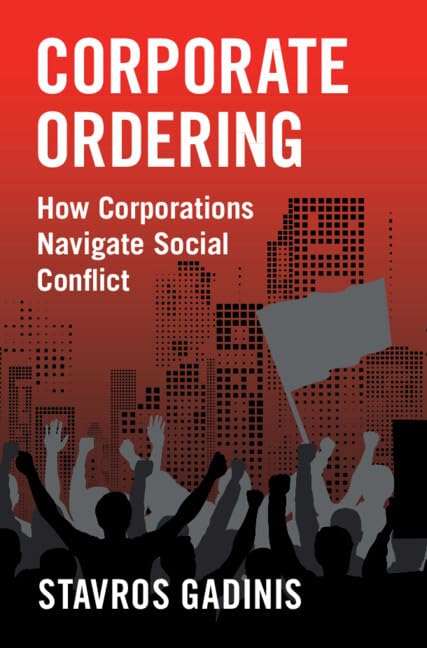 |
Corporate Ordering explains how modern corporations navigate social conflict when law is incomplete, politics are polarized, and shareholders disagree about corporate purpose. Drawing on original case studies from ridesharing, climate sustainability, and artificial intelligence companies, the book reveals the internal governance systems corporations use to set standards, justify decisions, and monitor their impact. Moving beyond the familiar debates between shareholder primacy and stakeholder capitalism, the book offers a clear framework for understanding how corporate power actually operates in practice. Written for scholars, practitioners, policymakers, and informed general readers, it provides a timely guide to corporate governance in a world where business decisions increasingly function as social policy. |
SPEAKER BIO
Stavros Gadinis’ research examines corporate governance, corporate law, and financial regulation, with attention to the institutional framework through which rules are made, enforced, and integrated into corporate practice. He works across the boundary between public regulation and private ordering, tracing how standards form, how companies build internal systems to comply with them, and how courts evaluate the resulting arrangements. His scholarship reaches financial risk, environmental and social responsibility, and emerging technology, in both domestic and international settings.
His book Corporate Ordering (Cambridge University Press, 2026) develops a framework for how corporations organize themselves to navigate socially contested decisions ahead of formal regulation. The book traces the institutional infrastructure that companies have built for rulemaking, executive action, and monitoring, drawing on case studies in ridesharing safety, climate sustainability, and AI governance. It proposes a social business judgment standard for evaluating board decisions in this contested terrain.
On environmental and social issues, his work examines how companies construct internal governance and how external standards emerge to coordinate corporate behavior. Beyond the Brussels Effect (with Silvia Fregoni, 2025 Journal of International Economic Law) traces the rise of the International Sustainability Standards Board from private standard-setting to global baseline for climate disclosure. Social Business Judgment (2025 Business Lawyer) considers how courts evaluate board decisions that weigh social and environmental considerations alongside financial performance. The ESG Information System (with Amelia Miazad, 2024 Seattle University Law Review) studies the internal systems through which companies gather and process information on social risks. Corporate Law and Social Risk (with Amelia Miazad, 2020 Vanderbilt Law Review) treats stakeholder outreach as a governance system through which firms identify and respond to emerging social pressures.
A second strand concerns the internal compliance and reporting systems that mediate between corporate decision-making and external accountability. The Hidden Power of Compliance (with Amelia Miazad, 2019 Minnesota Law Review) shows how extensive internal reporting reshapes director liability. The Quest for Legitimacy (with Christopher S. Havasy, 2024 UC Davis Law Review) draws on public law to address concerns about the legitimacy of corporate power.
His financial regulation scholarship addresses the institutional architecture of standard-setting and regulatory oversight. Three Pathways to Global Standards (2015 American Journal of International Law) shows how the institutional source of financial standards, whether private, regulatory, or governmental, produces distinct results in their global diffusion. From Independence to Politics in Financial Regulation (2013 California Law Review) traces how post-2008 reforms expanded political control over independent financial regulators.
Gadinis serves as Faculty Director of the Berkeley Center for Law and Business, where he runs the Fall Corporate Governance Forum, the Spring M&A Forum, and the Berkeley Corporate and Climate Summit. He teaches Business Associations and advanced corporate law courses, and supervises the Berkeley Business Law Journal. Before entering academia, he practiced corporate law in Europe for four years. He holds an S.J.D. from Harvard, an LL.M. from the University of Cambridge, and a law degree from Aristotle University in Greece.
Fees Applicable
Complimentary
Registration
Click here to register. Closing date is 11 December 2026.
CPD Points
This event is NOT a CPD-accredited activity. No CPD points will be awarded
Practice Area:
Training Level: