

Media - News
From India to Florence: A journey of conviction
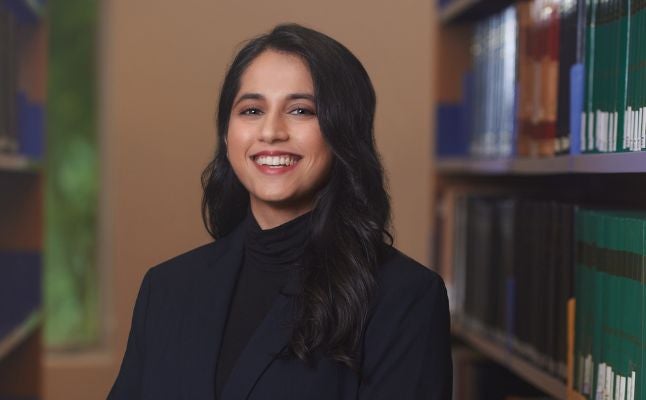
Congratulations to Kanika Jamwal PhD ’26, for being awarded the Max Weber Fellowship (MWF) at the European University Institute (EUI)!
One of the world’s most selective and rigorous multidisciplinary postdoctoral programmes, the Fellowship is a career-defining milestone. It accepts fewer than 5% of applicants for just 55 to 65 fellowships across the institute’s academic units. Fellows benefit from an inspiring, multidisciplinary environment in the heart of Europe.
For Kanika, it is the latest peak in a journey that began in the arid landscapes of Rajasthan, India, found its intellectual anchor in Singapore, and would now lead her to Italy.
The Start of Her Journey
Kanika’s road to becoming a legal scholar began at the Rajiv Gandhi National University of Law in Punjab, India, where her interest in environmental law first took shape. This foundation was later refined at the London School of Economics, where she pursued her Master’s in Public International Law.
Subsequently, she spent three years as an academic at Jindal Global Law School, where she published her early work and taught courses on environmental law, climate litigation and public international law. It was during her time there that she realised academia was a space in which she could meaningfully contribute to ongoing debates on environmental legal and policy issues.
The Thesis
In a nutshell, Kanika’s thesis explores community-led environmental governance. Inspired by childhood stories and a formative internship with an NGO, her work drills down to the grassroots level, and examines how local communities in rural India manage scarce water resources.
She shared, “My interest in water governance is not coincidental, but a culmination of different experiences from my formative years. For a better part of my childhood, I stayed in Rajasthan, an arid province in India. Years later, I pursued a field internship with an environmental NGO, where I interacted with women who had regenerated natural resources in their village. Using traditional ecological practices, they transformed a barren pasture to a green forest. That sparked my interest in community-led environmental governance, which became the central theme of my doctoral project.”
Finding a Home for the “Experimental”
Kanika faced a challenge in finding an institution that would be a right fit for her. Her proposed research was not just a project of law, but a project about the law, she explained—an unconventional socio-legal project that challenged the mainstream understandings of law. In doing so, it would foreground a form of water governance that had thus far escaped the imagination of legal scholars working on water law in India. “While this makes it unique, it also makes it experimental. My proposed research often encountered scepticism in legal academic spaces, especially concerning its fit within conventional legal scholarship,” she recalled.
However, she found her answer in Singapore. “I remember reading Associate Professor Jolene Lin’s Governing Climate Change: Global Cities and Transnational Lawmaking, and it stood out to me as an example of rigorous socio-legal scholarship that goes beyond state-centric approaches,” she said. Realising the issue wasn’t her research project, but about finding the right environment, she discerned that NUS Law offered an intellectual ecosystem where her research could genuinely thrive.
The NUS Experience
Kanika voiced her praise for the research environment at NUS Law, pointing to valuable peer reviews, mentorships, and logistical and financial support. Rigorous feedback and excellent mentorship from her thesis advisor, Associate Professor Lin, were instrumental in shaping her thesis and, more broadly, her academic career and professional development. She also benefited significantly from a close-knit PhD community that met fortnightly for doctoral workshops to read and critique one another’s work, and from the insightful feedback she received from the Vice-Dean of Research, Professor Lynette Chua, who convened these workshops. Kanika expressed deep appreciation for the generous research grant to support conference participation and socio-legal projects.
For her doctoral research, Kanika had to travel to remote places in India, which required time and funding. “Cognisant of this, the Vice-Dean of Research and her Office supported me in every way possible. I was always provided with prompt and relevant financial and administrative support. This allowed me to focus on my research and not worry about anything else,” she highlighted.
Looking Ahead
The Max Weber Fellowship at EUI represents the next evolution of her research. While her work is grounded in India, it speaks directly to the global movement on the Rights of Nature, and would bring a local perspective to a global discourse. “Given the diversity of researchers at the EUI, and particularly in the MWF, I believe it is a great space to develop my research in the global context that I hope to.”
Reflecting on how momentous this is for her career as a legal scholar, Kanika said, “The opportunity to develop my research in a multidisciplinary environment has to be one of the most exciting aspects of the MWF. A solid advantage of working in such an environment is that it helps in foregrounding assumptions in one’s research. This makes the research thorough and rigorous.”
Even as she’s poised to head to Florence, she remembers the road she took to get here. To those looking to enter the NUS Law’s PhD Programme, she advised the following. In her own words, she said:
Passion: Choose a topic that excites you and can keep you engaged for at least four years. I still feel equally, if not more, excited about my project compared to when I started.
Clarity: Ensure that your proposal has a clear research question and demonstrates a preliminary understanding of how you are advancing knowledge in your chosen subject area.
Authenticity: Your statement of purpose and personal statement should be a reflection of you. These two documents are your first opportunity to “speak” with the Selection Committee without being physically present. The best way to leave a lasting impact is to be authentic and true.
After finishing her doctorate, Kanika wants to resume her career as a full-time academic in the global market. When asked about the real-world impact of her work, she emphasised that in the face of today’s multi-scalar environmental crises, governance cannot remain a top-down, state-led process. “Although community-led governance has certain limitations that require further exploration, these do not diminish its relevance in addressing current environmental challenges.”
We wish Kanika well that even as her research takes a modest step in this direction, it will have far-reaching results in years to come.
Click here for more information on the Doctor of Philosophy Programme.