

Media - News
How Shaun Wittberger found his voice at the podium
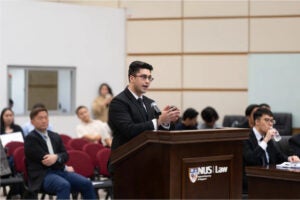
When Shaun Alexander Wittberger ’27 looks back on his school days, public speaking was the last thing on his mind. A self-described reserved primary school pupil, Shaun avoided situations that put him in the limelight.
It took a gentle push from his mother in secondary school—encouraging him to join the St Joseph’s Institution (SJI) Debating Society—to shift his perspective. Guided by coaches at SJI and later Anglo-Chinese Junior College, Shaun grew to embrace the art of oral advocacy. What began as a challenge to build self-confidence eventually led him to NUS Law, with mooting being the natural progression in a journey towards becoming a more effective orator.
Beyond the Script
Shaun entered law school believing that oral advocacy was simply the polished delivery of a meticulously prepared speech. His first competitive experience at the 2024 Advocacy Cup quickly shattered that assumption.
In a trial advocacy setting centred on cross-examination, Shaun faced an opposing witness who evaded questions, went on tangents, and pretended to cry. “My naivety was exposed almost immediately,” Shaun recalled. “I had to formulate a new line of questioning on the spot. It taught me that oral advocacy is not about reciting a script. It is about understanding what needs to be proven and being adaptable enough to take different routes to get there.”
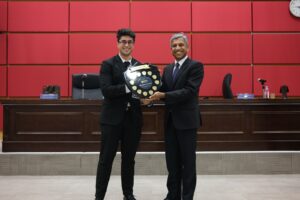
Shaun went on to win the competition that year, setting off a string of podium finishes across domestic and international stages.
Growth Under Fire
Another turning point in Shaun’s advocacy style occurred during the 2024 B.A. Mallal Moot. Confident in his calm and measured delivery, he was caught off-guard when a judge asked if he was “pitching his case too high”.
Shaun realised that the effect of having a measured, reasonable tone would be lost if his case narrative was unreasonable, and put this lesson to work at the 2025 Covenant Chambers Equity & Trusts Moot Competition. Shaun calibrated his submissions—framing an unconscionability argument that satisfied the legal thresholds, without denying his case’s inherent weaknesses. The result? He claimed both the Champion title and the Best Speaker award.
“These experiences have taught me that mooting is also about how one frames their position to appear more credible before a judge,” he reflected.
A Winning Argument
When asked what elevates a legal submission, Shaun pointed to two things he gleaned from experience. First, the application of facts: Good facts should be front and centre of an argument, bad facts should be addressed to neutralise damage, while red herrings lack legal weight.
Second, one’s response to judicial questioning. While he used to hold the mentality that a silent Bench was a persuaded Bench, his mindset soon changed. “A silent Bench could be silent because the argument is off-point or confusing. The only way to know for sure is to be open to questions and be more attentive to their facial cues,” he said.
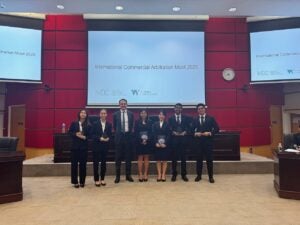
The finals of the 2025 WongPartnership International Commercial Arbitration Moot proved the point. A judge persistently challenged the commercial reality of Shaun’s expert report but, rather than conceding, Shaun reframed his angle on the fly, demonstrating how two conflicting expert reports could be reconciled—a pivot that earned praise from the Bench.
When faced with disappointing moot outcomes, Shaun returned to the basics. “I always remind myself that I moot not for the sole objective of winning but to partake in a process of learning to become more skilled in the craft of legal advocacy.”
Striking a Balance
Shaun acknowledged that the challenging part of balancing academic commitments with mooting is the time-intensive research process. “The majority of issues in moot problems pertain to either areas with little case law or an abundance of hugely contested materials. Also, there is no definitive way of knowing whether the cases you are researching are beneficial to your argument.”
Indeed, the amount of research for international moots is even higher, requiring an understanding of international regimes underpinning disputes in question. The preparation also included being cognisant of the fact that the argument would be heard by judges from different legal jurisdictions.
Nonetheless, the process has helped in strengthening his prioritisation skills and legal research. “Even though there have been trade-offs that I have had to make, the payoff has always been worth it.”
The NUS Law Community
Shaun emphasised that advocacy at NUS Law is a team effort. From senior mooters dialling in across time zones during study exchanges to listen to submissions, to alumni scheduling coaching sessions and faculty providing mentorship, the support network runs deep.
The mooting culture at school is both encouraging and nurturing, said Shaun, elaborating that there is a clear philosophy of giving as many students as possible the opportunity to represent NUS Law at international competitions. “There is a strong tradition of passing it on to the younger generation,” he explained, referencing regular mooting workshops held for first-time competitors.

The collaborative spirit among the students was also something Shaun valued deeply. At the Covenant Chambers Equity & Trusts Moot Competition, peers helped to bench Shaun and teammate Tyrone Tham, which helped improve the language and substance of their arguments.
Shaun also credits advice given by his older brother, an NUS Law alumnus, as his guiding principle: always master the case theory first. A clear, persuasive narrative explaining why a dispute arose and why the relief is fair underpins every successful argument.
Looking Ahead
As Shaun looks towards graduation, his experiences across commercial litigation and international investor-state arbitration have solidified his career aspirations. He plans to pursue commercial dispute resolution and international arbitration.
To incoming freshmen who might feel intimidated by the podium, Shaun offered clear advice: “Moots are self-directed—the pressure is limited to what you place upon yourself. This gives you the freedom to explore, fail and learn without fear. It may be intimidating, but the mentorship and support provided by the faculty, seniors and alumni foster a nurturing environment. It is a unique law school experience that I would recommend to everyone.”