

Media - News
NUS Law Open House 2026: A case for coming home
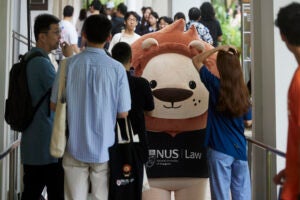
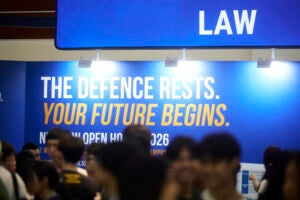
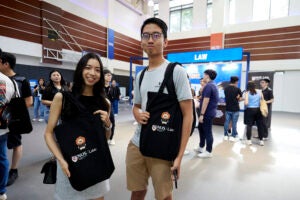
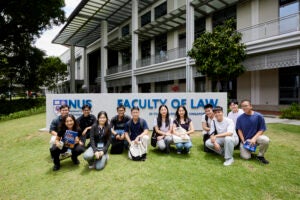
On 7 March 2026, the NUS Law Open House welcomed some 2,500 visitors, marking its first back at the Kent Ridge campus in almost two decades. The event symbolised a homecoming, offering visitors a renewed vision of campus life. Through the line-up of activities including talks, masterclasses and mock moots, visitors were given a glimpse into the NUS Law experience.
Finding Your Place in the NUS Law Community
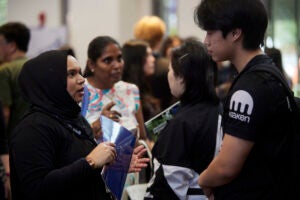
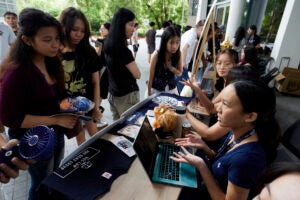
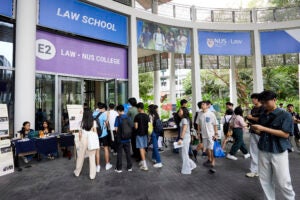
From the moment the doors opened, the NUS Law booth quickly became a hub of activity. Faculty, staff and students welcomed visitors, sharing insights into student life, exchange programmes and career services, while fielding a steady stream of questions on academic, application and admission matters. Current students were enthusiastic in sharing their personal experiences from mooting to pro bono work, from international competitions to overseas exchange programmes.





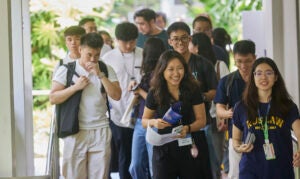
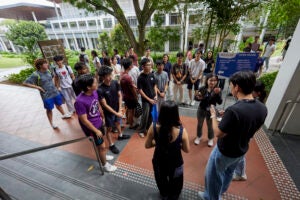
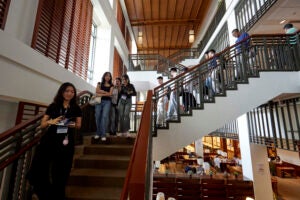
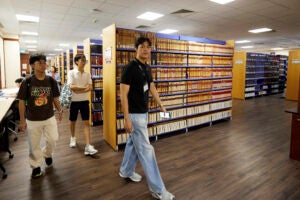
The sense of “homecoming” was most palpable during the student-led tours of our new facilities, especially the storied CJ Koh Law Library and the Wee Chong Jin Moot Court. Though the setting is new, these cornerstone institutions ground the law school at Kent Ridge, making it clear that this move is a true reconnection—a return to the wider NUS community where our history and future sit side by side.
Choosing a Way of Thinking
In his opening address, Professor Andrew Simester, Dean of NUS Law, cut through the usual rhetoric of prestige and career prospects. He urged students to choose law for the right purposes and only if they are ready to be present, engaged and fiercely interested. Choosing to be a lawyer for the financial incentives alone “will not be enough to see you through the challenges of life in practice”, he stressed.
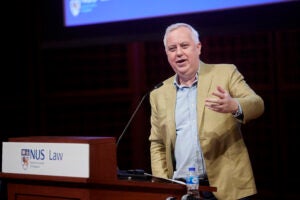
Prof Simester encouraged students to think about the law as a way of solving problems, underscoring the fact that a legal education and career are about analysing, interpreting and applying rules to real-world situations to solve clients’ problems. An NUS Law education imparts distinctive, world-class skill sets to students, earning the Faculty a spot among the world’s best law schools.
“Lawyers have the ability to change people’s lives, and you can do that for good and bad,” Prof Simester concluded. “Lawyers have the power to advance the realisation of justice in our community.”
Shaping Future-ready Lawyers
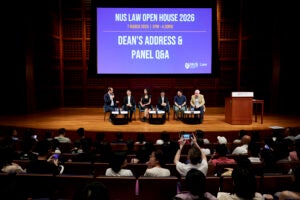
After his address, Prof Simester invited the guest speakers on stage for a panel Q&A session. The panel included Professor Christian Witting, Vice-Dean of Academic Affairs; Associate Professor Tan Zhong Xing ’12; Desmond Chng ’15, Director of Dispute Resolution at Drew and Napier LLC; Sadhana Rai ’12, Chief Representation Officer at Pro Bono SG; and Chia Zhen Kai ’28, President of the NUS Law Club.
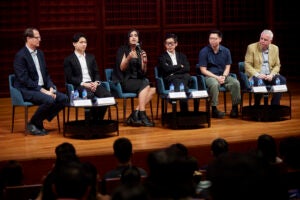
Among the key questions raised was the impact of AI on the law profession. On that point, Sadhana spoke resolutely, “To draft better prompts, a solid understanding of the law is fundamental. AI doesn’t render lawyers redundant; it renders lawyers who don’t know how to use AI redundant.”
Desmond reiterated that as long as human judges remain on the bench, human lawyers are needed. Quoting Chief Justice Sundaresh Menon, he said, “the adjudication of law is a human endeavour,” highlighting that lawyers must critically assess AI’s output for hallucinations and inaccuracies.
Even as the profession evolves, human judgment and reasoning remain vital. Prof Witting reinforced that AI runs out when data runs out. “We need to think about ways laws will develop,” he opined. He emphasised that NUS Law trains students to be forward-looking. Through the compulsory Law and Technology course, third-year students are taught basic coding and design-thinking skills to navigate legal issues in the digital realm.
As expected, many questions revolved around how to get accepted into NUS Law.
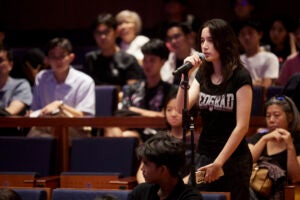
On the admissions interview, Associate Prof Tan shared that prospective students must hold two divergent streams of argument in their heads during the interviews and demonstrate a sound understanding of how the law intertwines with other disciplines or society at large.
Zhen Kai also reminded prospective students of the need to get their academic priorities right and explore their interests and make the best of the experiences they have.
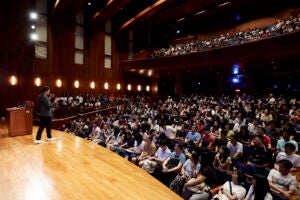
The strong turnout mirrored the Welcome Talk held earlier in the morning by the Vice-Dean of Student Affairs Justin Tan, which saw long queues that eventually filled the two storey performance hall venue.
Stepping Into the NUS Law Classroom
To give visitors a glimpse into what learning at law school is like, the activity line-up included two masterclasses.
In the first masterclass, Associate Professor Tan Hsien-Li explored ASEAN’s place in the international legal system. Even smaller states and regions, like ASEAN, can exercise influence through legal frameworks and cooperation.
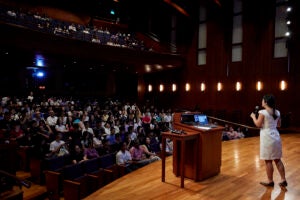
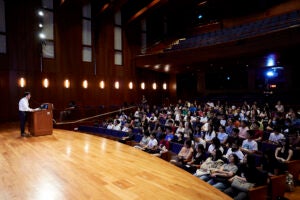
But the session also carried a practical reminder that “rules are dead without implementation”. Beyond theory, the law is about how rules are created, applied, and given effect in the real world. Lawyers play a huge role in ensuring that “for everyone to thrive, laws are made fair, transparent, and are implemented”, she emphasised.
In the second masterclass, visitors were presented with a familiar pop culture figure, the Marvel Universe’s Thanos, and asked a deceptively simple question: Did Thanos commit genocide?
Many instinctively thought so. However, as Associate Professor Mervyn Cheong unpacked the issue with reference to international criminal law standards, genocide, as they soon learnt, depends on very specific criteria, including intent and the targeting of specific groups.
The takeaway was that the “right” answer is rarely the most immediate one. At times, there might not even be a right answer, and students must learn to grapple with the discomfort of that.

“Students sometimes conflate questions of what the law should be and how the law should apply,” Associate Prof Cheong shared. “Students who perform better holistically are reflective. They ask themselves if the law should or should not be as such, in its current state.”
For most of the visitors, this was the first time they attended a masterclass on law, and the experience broadened their views on the real-world effects of legal theories, as well as the complexities of the application of law.
Finding Your Voice: The Moot Experience
If the masterclasses showed how NUS Law students think, the mock moots demonstrated how they speak. In a simulated courtroom setting, students presented arguments, responded to questions, and defended their positions under pressure.
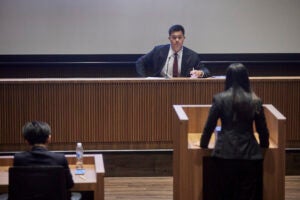
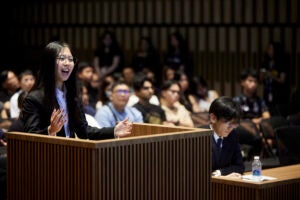
Open House visitor Estelle thoroughly enjoyed witnessing the mock moots which revolved around an insurance law issue concerning an accidental death on a flight with extreme turbulence. “Even as an introvert, it seemed very interesting and the way the speakers presented their arguments was inspiring. If that’s what I’ll be like next time, I’m down.”
Estelle’s mother, Mary, added that it was heartening to see students’ effort in showcasing their best arguments. Even with the tense atmosphere, the mooters were unfazed and put their best foot forward—a signature of NUS mooters.
Student Ng Shin Huey ’28, who represented the appellant in the mock moots, said, “International moots open a whole new world, from foreign legal issues to unfamiliar procedural requirements. Mooting isn’t about chasing glory, but a fantastic learning opportunity to try new things in a low-risk environment. Those experiences really change your law school experience.”
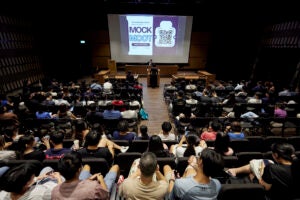
Kim Minjae ’28 who acted as the respondent said, “First-year students spend a year taking the compulsory Legal Analysis, Research and Communication (LARC) course. So, the final moot feels like an inauguration into law school. As I practised, I grew more comfortable. I now represent NUS at international advocacy competitions, which is a huge step from where I used to be.”
For prospective students and their parents, the mock moots were an eye-opening showcase of a key aspect of the NUS Law curriculum, which cultivates in students not only the technical skill, but also develops in them confidence and the ability to think on one’s feet.


Coming Home, Looking Forward
As the Open House came to a close, the idea of “homecoming” lingered. Surrounded by the buzz of University Town, NUS Law’s new premises represent more than a relocation; they signify a meaningful return to our roots within the wider NUS community. And at the end of the day, prospective students walked away with a clear view of the strength of our schooling and the vibrancy of our campus life, anchored both in heritage and the broader shared belonging to the NUS family.

For more information on NUS Law, visit our website here.
Reporting by:
Michaela Oey ’28
Faculty of Law, National University of Singapore