
Media - Global News
Professor Julian Arato delivers Sat Pal Khattar Professorial Lectures
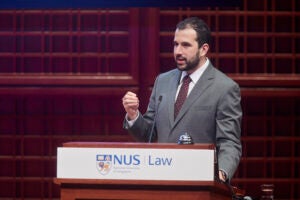
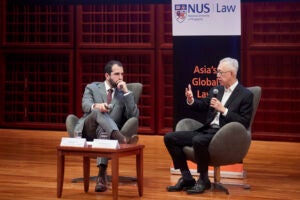
Professor Julian Arato, whose scholarly expertise spans the areas of public international law, international trade, international investment law and arbitration, contracts and corporations, gave two lectures in March 2026 at the Performance Hall of the National University of Singapore Faculty of Law, in his capacity as the Sat Pal Khattar Professor.
Chaired by Professor Tan Cheng Han, S.C. ’87, Chief Strategy Officer at NUS Law, the lectures dealt with “Trade Unilateralism, From American Exceptionalism to America First” (9 March), and “The Corporation in International Law” (11 March).
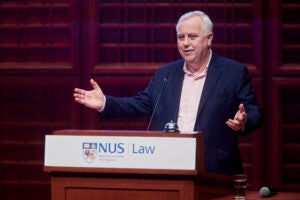
In the first, Professor Arato spoke about the need to reconsider the America First trade agenda, which is often portrayed as a volte face in American foreign policy. He argued that while it was true that the US long championed trade multilateralism—from the formation of the General Agreement on Tariffs and Trade (GATT) in 1947, to the reformation of the World Trade Organisation (WTO) in 1994, through the Obama years—it has continually insisted on maintaining and deploying a range of legal options to act unilaterally within the system.
Tracing the unilateral streak in US trade policy across three periods, Professor Arato made the case that the continuities in American trade policy from 1947 to the present are as important as the ruptures in understanding the current climate. Picking up the pieces, he said, will require confronting not only the nihilism of America First, but the more deeply ingrained ideology of American exceptionalism.
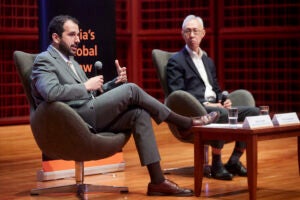
In his second lecture, Professor Arato discussed the problematic concept of business corporations in public international law—conventional wisdom is that classical international law does not recognise corporations as international legal persons. However, he made the case that private corporations are already so. But, unlike states and international organisations, the international legal status of corporations is ad hoc rather than categorical—addressed irregularly and inconsistently across different treaty-based regimes, including human rights treaties and international investment agreements.
As a result, corporations have long been able to enjoy the powers and privileges of international legal personality while completely avoiding its associated liabilities, said Professor Arato, as he highlighted that the time has perhaps come to bring them more fully into the system.
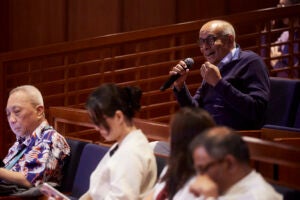
The Sat Pal Khattar Professorship in Law was endowed by Mr Sat Pal Khattar ’66 LLM ’71 and family. A prominent lawyer, businessman and community leader, Mr Khattar established a leading law practice (Sat Pal Khattar Co, renamed KhattarWong & Partners, now known as WithersKhattarWong) and heads an investment firm (Khattar Holdings).
Born in India, Mr Khattar moved to Singapore in the 1950s, where he helped in his father’s business in his teens. Before setting up his law firm, he entered the civil service and was awarded the Public Administrative Medal (Silver) in 1972. After retirement, he remained chairman of his private investment firm and held chairmanship and directorship of several organisations.
In recognition of his contributions to the labour movement, he had also been honoured on a number of occasions at the May Day Awards.
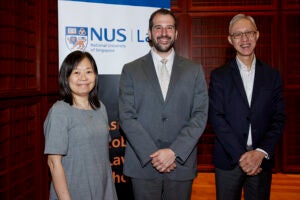
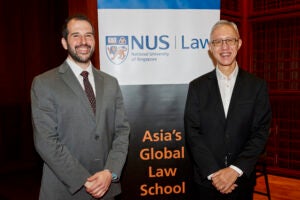
About Professor Julian Arato
Julian Arato is a Professor of Law at the University of Michigan. His scholarly expertise spans the areas of public international law, international trade, international investment law and arbitration, contracts and corporations.
Professor Arato is an author of International Law: Cases and Materials (8th edition). He is also an author of International Trade Law Through the Cases (2025 edition). His article, “The Private Law Critique of International Investment Law”, won the 2019 Francis Deak Prize for Best Article by a Younger Author published in the American Journal of International Law, as well as the inaugural ICCA—Guillermo Aguilar-Alvarez Memorial Prize.
Professor Arato is on the board of editors of the American Journal of International Law, a member of the executive board of the European Journal of International Law (EJIL), and an editor of the EJIL:Talk! blog.