

Media - Global News
Professor Norman Ho delivers Kwa Geok Choo Distinguished Visitors Lecture
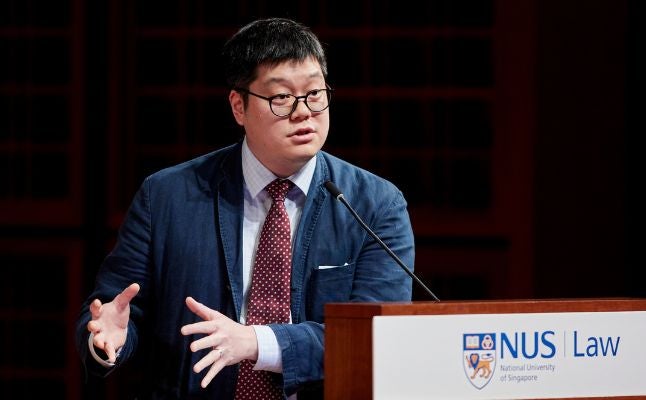
On 26 February 2026, Professor Norman Ho delivered a lecture titled “Rethinking Confucius’s (and Confucian) Legal Thought” at the performance hall located on the Kent Ridge campus of the National University of Singapore, Faculty of Law.
Many scholars and commentators like to use the adjective “Confucian” to describe aspects of Asian legal systems. But what does Confucian mean? The usual explanation goes something like this: Confucius (c. 551-479 BC), the founder of the Confucian school, believed law was a lower norm in society; rather, society should be regulated primarily through ritual, buttressed by self-cultivation and learning. We should be merciful and punishments should be used in moderation.
The explanation often then contrasts Confucian with “Legalist” thought—describing how ancient Chinese “Legalist” philosophers held up the law as the primary norm in society and who advocated for harsh punishments even for minor offences.
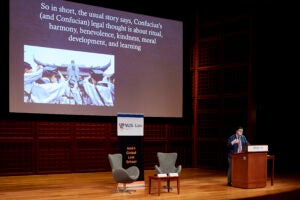
In his lecture, Professor Ho argued that the usual explanation that contrasts Confucian with “Legalist” legal thought is not fully accurate. This usual explanation focuses too much on the Analects (sayings of Confucius) as its primary source and largely ignores other important sources of Confucius’ thought, including his own biography and sources such as the Kongzi Jiayu (literally translated as “Family Sayings of Confucius”).
Taking these sources into account forces us to rethink Confucius’ (and Confucian) legal thought as one which arguably shares a lot more in common with what many consider to be “Legalist” positions and orientations.
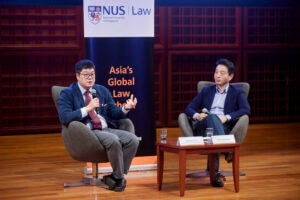
Professor Ho also raised broader questions that are not limited to Confucius or Chinese legal thought—How do we re-evaluate a figure’s legal thought when new sources are considered? How relevant is a figure’s biography in understanding his/her jurisprudence? How do we deal with a situation where a legal thinker’s writings or sayings differ quite dramatically from how he/she applies the law?



His critical analysis led to a robust discussion of the topics raised, leaving the audience to ponder the complexity behind Confucian legal thought long after the lecture ended.
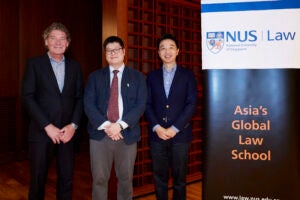
About Professor Norman Ho
Professor Norman P. Ho is a Professor of Law at Peking University School of Transnational Law. He writes and teaches in the areas of property law, legal theory, Chinese legal history, and law and the humanities (especially the intersections between law and music). Prior to entering academia, he practised in the law firms of Slaughter and May and Morrison & Foerster. He holds a Bachelor of Arts and Master of Arts from Harvard University, a Master of Arts (with Distinction) in Music from The Open University (UK), and a Juris Doctor degree from the New York University School of Law.