

Media - News
SLR Lecture: Mr Murali Pillai on the bicentennial anniversary of law in Singapore
The year 2026 marks a significant milestone in Singapore’s legal and, indeed, national history. As the bicentennial of Singapore’s modern legal and judicial system, the year opened with an important lecture organised by the Singapore Law Review (SLR), Asia’s oldest student-run legal publication that is managed exclusively by students of the National University of Singapore, Faculty of Law.
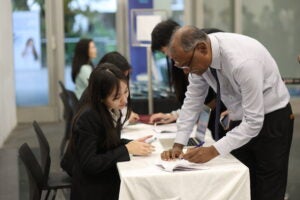
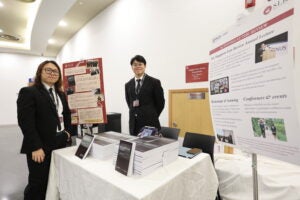
On 9 January 2026, Mr Murali Pillai S.C., the Senior Minister of State for Law & Transport, delivered the 37th Singapore Law Review Lecture at NUS University Town, following the Faculty of Law’s relocation from the Bukit Timah campus to Kent Ridge.
As Mr Murali highlighted, Singapore’s modern legal and judicial system was established in 1826 by the Second Charter of Justice. This foundational document introduced a unified system of laws applicable to all residents, regardless of race, culture or religion. At its core lay the essence of the Rule of Law, a principle that has remained fundamental to Singapore’s governance and nation-building to this day. It is against this historical backdrop that Mr Murali delivered a thoughtful and timely reflection on Singapore’s legal development and the enduring role of the Rule of Law.
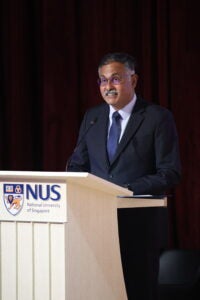
Drawing on history and contemporary challenges, the lecture examined how the Rule of Law has shaped Singapore’s legal and judicial institutions over 200 years, and why it must continue to evolve in a rapidly changing world. For its value to be truly harnessed, the Rule of Law was given meaningful expression within Singapore’s unique social and economic context. Mr Murali aptly quoted Singapore’s founding Prime Minister Lee Kuan Yew when he said that the task was to “bridge the gulf between the ideal principle [of the Rule of Law], and its practice in our given sociological and economic milieu”.
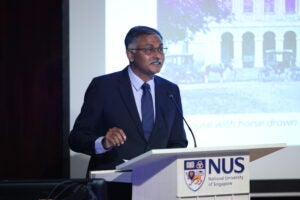
Mr Murali also addressed the delicate balance between individual rights and collective interests, and the role of law in sustaining a safe, stable and forward-looking society. To illustrate Singapore’s approach to the Rule of Law, he zoomed in on three specific areas in which it has been integral to the nation’s development and success. First, economic progress (including the legal innovations introduced in response to the unprecedented economic crisis prompted by the Covid-19 pandemic); second, the preservation of racial and religious harmony; and third, access to justice.
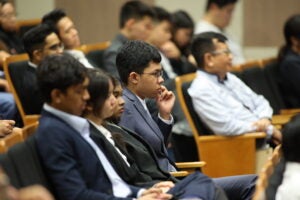
Importantly, as he emphasised during the question-and-answer segment, the lecture was not intended as a declaration that Singapore has “done well” and has “arrived”. Rather, it was a recognition that Singapore has developed a legal system that has worked for its circumstances thus far. But that system did not arise from a single moment of creation completed two centuries ago. Instead, the law and Singapore’s commitment to its rule, is an ongoing, everyday endeavour. The Rule of Law is a modern undertaking, which all of us must continue to make real.
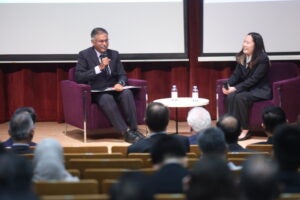
As Singapore marks this historic milestone, the challenge ahead is twofold: to safeguard what has been achieved, and to build further upon this foundation for future generations. In an age of war and uncertainty, technological upheavals and a new world order, the Rule of Law must be exercised with greater dexterity and imagination than before, yet anchored by the same understanding of its purpose and its power. This power, and the ability to evolve to fit new circumstances, must come from the future leaders of Singapore.
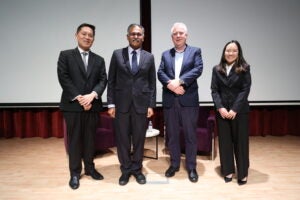
Perhaps, two hundred years from now, the Rule of Law will take a different form. What remains certain, however, is that it must continue to evolve if it is to serve the common dream of all who live, work, and make their own personal histories here.
Until the next bicentennial.
The lecture will be published in the Singapore Law Review in the second half of 2026. Organised by the Singapore Law Review, the oldest student-run publication in Asia and managed by students at NUS Law, and sponsored by Herbert Smith Freehills Kramer Prolegis Alliance this year, the annual lecture aims to create awareness of current legal issues and promote legal thought and discussion amongst law students. For more on the SLR, please visit https://www.singaporelawreview.com/.
Reporting by:
Zhang Kexin ’27, Singapore Law Review
ABOUT MR MURALI PILLAI
Mr Murali Pillai S.C. is the Senior Minister of State for the Ministry of Law and Ministry of Transport. He holds LLB (Hons) and LLM degrees from the National University of Singapore Faculty of Law, along with double MBA degrees from the University of California Los Angeles and NUS. After graduation, he became a senior police officer before joining private practice as a lawyer in 1996. He was appointed Senior Counsel in 2020. He is currently a third term Member of Parliament, having been first elected through a by-election in Bukit Batok SMC in 2016.