

Media - News
World champions: NUS Law clinches historic fifth Jessup title
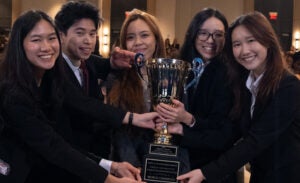
After a 25-year wait, the “World Cup” of mooting returns to the National University of Singapore Faculty of Law. In a stunning display of legal prowess and grit, the NUS Law team emerged victorious at the 67th Philip C. Jessup International Law Moot Court Competition.
Facing off against over 800 teams from more than 100 jurisdictions this year, the NUS Law team—comprising Phoebe Chan ’26, Tan Kai Han ’26, Lee Dawn Gene ’26, Natalie Koh ’26 and Caleb Tan ’26—secured the world championship in Washington DC after an intense final round against Ateneo de Manila University.
A Historic Milestone
This victory marks a significant moment in the school’s history: This is the faculty’s fifth Jessup world title and the first since 2001. NUS has made the grand final some 13 times, easily the most of any law school in the world. Winning the Jessup is not merely an extracurricular achievement, it is a validation of the NUS Law curriculum and its ability to produce world-class advocates. By navigating complex public international law issues, these students have proven they can beat the best legal minds in the world.
NUS Law Dean, Professor Andrew Simester, said, “This is a crowning achievement for our students and another proud moment for Singapore. Reclaiming the Jessup title underscores the enduring strength of the NUS Law curriculum in sharpening the reasoning and advocacy skills of our students. We are immensely proud of Phoebe, Kai Han, Caleb, Dawn and Natalie. They have proven once again that our legal talent is truly world-class. More than world class: they are world-best.
“This did not happen by accident. It happened because of the enormous amount of work our talented students put into this competition. At the same time, their success is also a testament to their coaches: our selfless alumni community. NUS Law is a family, built across generations, and every student who does well stands on the shoulders of those who went before. The hours that our alumni spent mentoring our team paid off. Every triumph is a team effort. It is part of the legacy that NUS continues to build for Singapore.”
Mastery Under Pressure
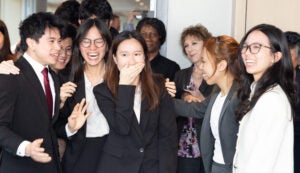
The final round saw NUS Law acting as the Applicant before a distinguished bench including Professor Dapo Akande (University of Oxford), Professor Soledad García Munoz (Georgetown University) and Professor James Anaya (University of Colorado). The team tackled complex public international law issues ranging from the consultation of indigenous peoples regarding sacred lands to the intricacies of sovereign immunity for state-owned enterprises.
Kai Han was awarded Best Oralist of the final round, while Phoebe was recognised as a Top 50 Oralist in the preliminary rounds.
Singapore’s Minister for Law and Second Minister for Health, Mr Edwin Tong, praised the duo for their performance. He wrote in a Facebook post, “For a full 1.5 hours, they were calm, composed and completely in command. Their submissions were crisp, structured and incisive … they displayed a quiet authority and maturity well beyond their years.”
While Kai Han and Phoebe took the podium in the final, the victory was a collective effort. Dawn, Natalie and Caleb played crucial roles in the earlier rounds, helping to propel the team to the grand final.
“Mooting is a Muscle”
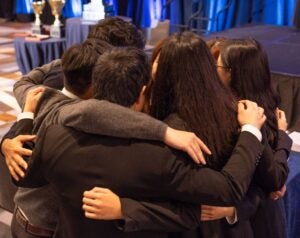
The road to Washington DC was paved with months of relentless preparation. The team credited their success to a dedicated coaching staff— Timothy Chong ’21, Clara Low ’22, Melvinder Singh ’23, Tan Fong Han ’20 and Jerald Tan ’22—and a community of alumni who returned to “bench” the students in practice sessions.
“As our coaches like to say, mooting is a muscle,” said Kai Han. “Leading up to the competition, we had multiple practice sessions a week to work that muscle, and this consistent practice was one of the things that helped us to cope with nerves.”
She added, “The constant reassurance, trust and support from our coaches was invaluable in helping us feel ready.”
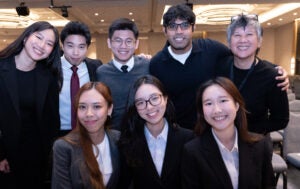
For Phoebe, the significance of the journey extended beyond the trophy. “The friendships, camaraderie, mutual trust and laughs are memories I will hold dear to my heart in years to come,” she shared, noting the immense support received from family and the law school community via a dedicated Telegram cheering squad.
As the team prepares to bring the Jessup Cup back to the Kent Ridge campus, the Faculty celebrates a new generation of absolute legends who have flown the Singapore flag high on the world’s most prestigious legal stage.
About Jessup
The Philip C. Jessup International Law Moot Court Competition is an advocacy competition for law students. It is the world’s largest such competition, with participants from roughly 700 law schools in 100 countries and jurisdictions. The competition is a simulation of a fictional dispute between countries before the International Court of Justice, the judicial organ of the United Nations.
The Jessup Competition is named after Philip C. Jessup, the United States representative to the International Court of Justice, who was elected by the United Nations to serve a nine-year term in 1961.
This year’s moot problem involved:
– consultation of indigenous peoples in state projects involving sacred indigenous lands
– whether transnational double jeopardy exists as a general principle of law barring extradition
– whether a state-owned enterprise is entitled to sovereign immunity in a wrongful death suit before a foreign court