

Media - News
Distinguished Visitor Lecture: The New Corporate Law of Corporate Groups
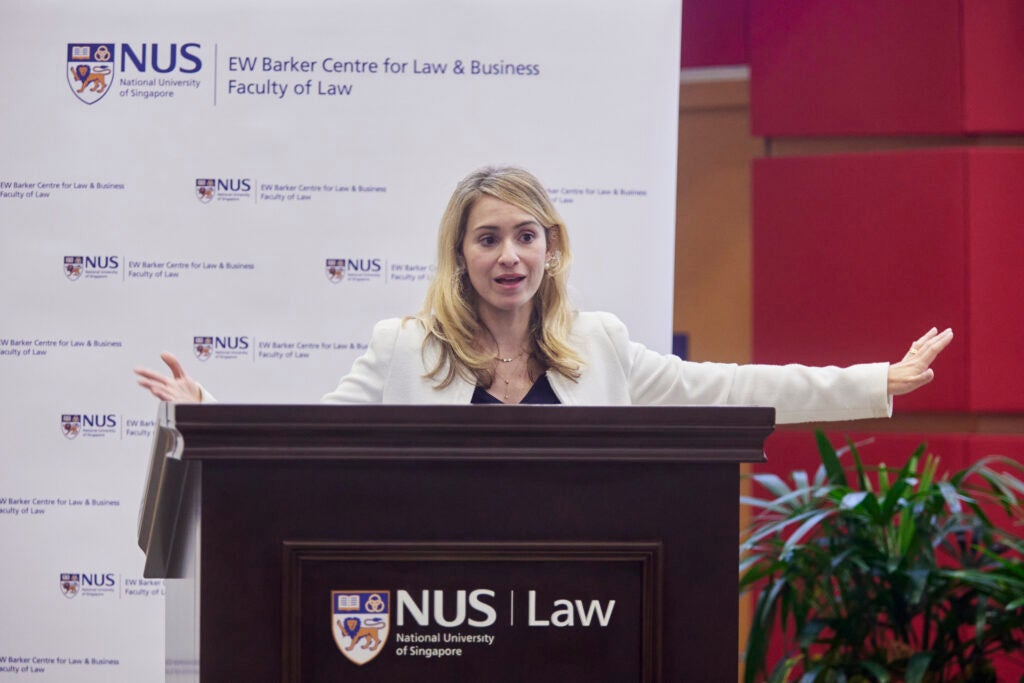
On 15 January 2025, the EW Barker Centre for Law & Business Distinguished Visitor Lecture titled “The New Corporate Law of Corporate Groups” was presented by Professor Mariana Pargendler, Beneficial Professor of Law at Harvard Law School. This lecture was chaired by Professor Tan Cheng Han, S.C., Chief Strategy Officer at NUS Law.
The lecture explored how corporate law treats legal entity boundaries in corporate groups, particularly where shareholder rights are concerned. Professor Pargendler commenced her lecture by highlighting a salient development in corporate law: the increasing erasure of entity boundaries where corporate law rules are applied. This phenomenon, which she terms “entity transparency’, encompasses regulatory partitioning and its exception, “veil peeking”.
Regulatory partitioning establishes a legal separation between shareholders and corporations, restricting the imputation of rights and duties between them. Meanwhile, veil peeking arises where courts and legislatures “look through” this separation to attribute shareholders’ legal rights to the corporation. Entity transparency has gained traction across jurisdictions, reflected in legislative reforms and judicial decisions. In the United States, oversight liability – where shareholders hold directors accountable for the inadequate oversight of the company – operates within an entity transparency framework. A prominent illustration would be the landmark case of Caremark, where the parent company, Caremark, was held liable for sanctions that were imposed and to be paid to the shareholders of the Caremark subsidiary.
However, Professor Pargendler insightfully observed that while numerous jurisdictions are steadily advancing toward greater entity transparency in corporate law, the pace of this progression has been uneven. The United States and the United Kingdom have taken the lead in such developments, but other jurisdictions have been slower to follow suit. This uneven development has created disparities that may undermine investor protection in lagging jurisdictions. Professor Pargendler suggested that the quicker developments in the United States and the United Kingdom can be explained by the prevalence of wholly owned subsidiaries in those jurisdictions, as the justification for entity transparency is stronger and more apparent in the context of wholly owned subsidiaries. In contrast, jurisdictions such as Brazil and India, where wholly owned subsidiaries are significantly less common, have experienced comparatively slower progress in moving towards entity transparency.
Professor Pargendler then tackled the central puzzle at the core of entity transparency. The rise of entity transparency and the continued recognition of limited liability produces a seemingly puzzling outcome: shareholders often benefit from having it both ways. On one hand, the law upholds entity boundaries to shield shareholders from liabilities. On the other, it is willing to disregard these boundaries when applying corporate law rules to enhance shareholder protection. To that end, Professor Pargendler forcefully argued that the apparent inconsistency in the treatment of entity boundaries across different contexts can be rationalized and justified by recognizing the distinct nature of shareholders’ and creditors’ interests in those contexts. Preserving limited liability within corporate groups reduces creditors’ monitoring costs and the cost of debt capital. Meanwhile, increasing entity transparency in matters concerning shareholders reduces their monitoring costs and the costs of equity financing.
Professor Pargendler then discussed a fundamental challenge towards entity transparency: its tension with the choice of law principles that underpin corporate law. Traditionally, a company is governed by the lex incorporationis – the law of the place the company is incorporated. However, the application of entity transparency results in a company’s governing laws applying to its other related entities, even if the related entities are incorporated under the laws of a different jurisdiction. The lecture was concluded with a stimulating question and answer session.

Professor Tan Cheng Han, S.C., Chief Strategy Officer (NUS Law), leading an interesting Q&A session

Associate Professor Tan Zhong Xing (NUS Law) posing a question

(From left) Professor Mariana Pargendler (Harvard Law School), Professor Ernest Lim (NUS Law) and Professor Tan Cheng Han, S.C. (NUS Law)