

Media - Global News
Professor Brian Leiter delivers Centre for Legal Theory Distinguished Lecture
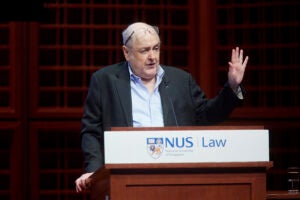
On 17 March, Professor Brian Leiter delivered a lecture titled “The Law and Philosophy of Academic Freedom” at the performance hall located on the Kent Ridge campus of the National University of Singapore, Faculty of Law.
A world-renowned legal philosopher, Professor Leiter—the Karl N. Llewellyn Professor of Jurisprudence and Director of the Center for Law, Philosophy & Human Values at the University of Chicago Law School—also took the time to give in-class lectures to our students on the topics of “Adjudication and Interpretation” (12 March) and “Authority” (18 March) during NUS Law Professor James Penner’s courses on Section of the Introduction of Legal Theory, and Philosophical Issues in Law.
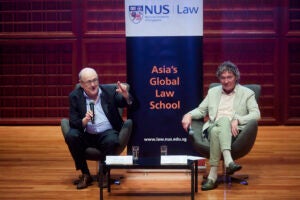
Core academic freedom protects a faculty member’s freedom in research and teaching subject only to the limitations imposed by the scientific discipline (the Wissenschaft) in which the faculty member works, where such limits are assessed by other experts in the discipline. Legal protections for academic freedom vary, and include statutory, contractual, and constitutional provisions. In his lecture, Professor Leiter discussed some representative Western and Eastern examples.
While academic freedom imposes more limitations on faculty expression (in research and teaching) than traditional “free speech” principles, it shares with the latter the same basic philosophical justification, deriving from Wilhelm von Humboldt (who created the modern research university) and whose arguments, in turn, influenced John Stuart Mill: Namely, that such freedom is conducive to the discovery and dissemination of truths, which is valuable for society.
To illustrate the force of the argument, Professor Leiter considered the debate between Mill and philosopher Herbert Marcuse over free speech, and why Marcuse, a skeptic about free speech, nonetheless believed in academic freedom. Professor Leiter concluded by considering the puzzle of academic freedom: Who decides what constitutes a Wissenschaft, when research and teaching is only justified if they proceed in accordance with the standards of a Wissenschaft?
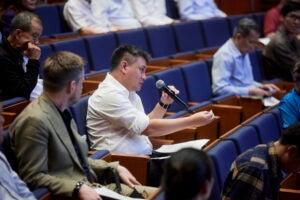
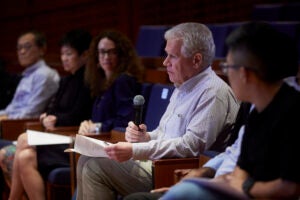
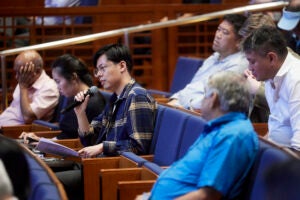
The Centre for Legal Theory (CLT) was launched on 5 February 2015 at NUS Law. The Centre brings together colleagues in the Faculty of Law interested in a variety of theoretical approaches to law, including those informed by related disciplines. CLT exists to promote formal and informal exchanges on theoretical work by members of the Centre, other NUS colleagues, and scholars around the world, and has hosted many of the world’s leading scholars.
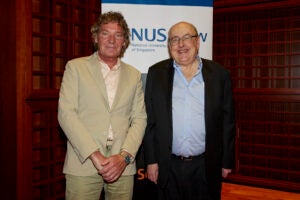
About Professor Brian Leiter
Professor Brian Leiter is the Karl N. Llewellyn Professor of Jurisprudence and Director of the Center for Law, Philosophy & Human Values at the University of Chicago Law School. He has also been a visiting professor of law or philosophy at Yale, Oxford, University College London, and the Universities of Rome III and Paris X. His books include Naturalizing Jurisprudence (Oxford, 2007), Why Tolerate Religion? (Princeton, 2013), Moral Psychology with Nietzsche (Oxford, 2019), and, most recently, From a Realist Point of View (2026), in the Oxford Legal Philosophy series.
His work has been translated into French, Italian, Chinese, Russian, Portuguese, Spanish, Japanese, Hebrew, Turkish, Polish, Slovak and Greek. He has delivered major lectures around the world, including the Paolo Bozzi Prize Address at the University of Turin, the Julius Stone Address in Jurisprudence at the University of Sydney, the Fresco Lectures in Jurisprudence at the University of Genoa (twice), the Taylor Lecture in Philosophy at the University of Otago, the ‘Or‘ Emet Lecture at York University in Toronto, the “Headliner” address at the annual Legal Theory Symposium at the National University of Singapore, and the opening plenary address at the 30th biennial World Congress of Legal and Social Philosophy in Bucharest. He is the founding editor of the Routledge Philosophers book series and of Oxford Studies in Philosophy of Law.